A look at the design, market and legacy of Victorian pottery

Showing posts with label Japonism. Show all posts

Sunday, June 24, 2012

The Art of Majolica. Pt. 2


Almost two years ago I did a post in this blog about the artist Louis Charles Moeller and the Art of Majolica. At the time I discussed the artist's use of the Wardle fan and bird pattern in his genre paintings. At the conclusion, I asked my readers to let me know if they were familiar with any other artists who used majolica in their work. Well, I never heard from anyone about it but I kept an eye open myself to try and locate similar situations. I never found any.

Earlier this year I did a post on the Choisy-le-Roi Aesthetic Series Plates. In that post I mentioned the strong influence of Japanese art on many Europeans including Vincent Van Gogh.


Have you ever heard the phrase "can't see the forest for the trees?" It is with great embarrassment that after two years I tell you of another artist who used majolica in his paintings—a very well known artist, in fact a great artist—and one whose work has become the very definition of impressionist art to many people: Vincent Van Gogh.

I was so embarrassed at discovering this, I even considered not sharing this information for the repercussions it might have to my reputation as a professional artist, but I thought about it and I realized that no one in the majolica community has ever made this connection before either, at least to my knowledge, so it may be of interest to my readers.

The work under discussion dates to one of the most creative and tumultuous periods in Van Gogh's life, the time he worked in the famous yellow house in Arles with Gauguin in late 1888. It was at this time that Van Gogh created some of his most iconic work including some of his early sunflower paintings. It was also during this time that part of his ear was cut off either by himself or in a fight with Gauguin.

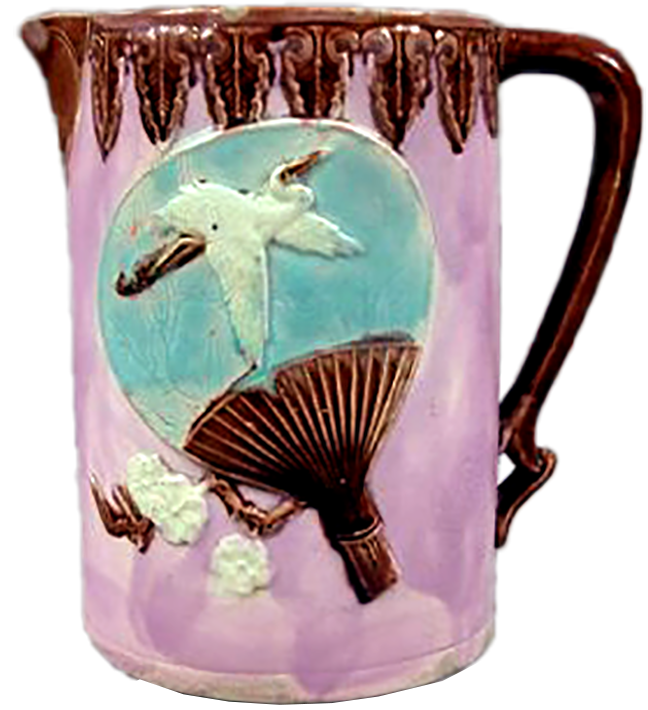
Van Gogh did many a still life over the course of that year and many of them featured flowers, but sunflowers were not the only flowers he painted. He also did a series of drawings and paintings of wildflowers, Oleanders and many others. Besides flowers he also assembled groups of household objects for other still life subjects. It is here we find that many of these used a large majolica pitcher that we would recognize today: this Japanese influenced one, attributed to Forester, with flying cranes on one side and prunus blossoms on the other.

Majolica  crane pitcher attributed to Forester
Reverse of majolica  crane pitcher attributed to Forester

I'm not sure how many paintings and drawings he did featuring this pitcher but he certainly did a number of them, some with a number of variations among them.


One slightly odd thing becomes apparent in viewing the paintings as a group however. There are two color variations of the same jug shown in the paintings: cobalt ground with turquoise basket weave, and cobalt ground with yellow basket weave. Did he have two of the same pitcher or did he use his imagination in creating the color palette for the paintings? I favor the former conclusion because both color combinations are known to exist in this pattern.

Isn't this an interesting thought? Imagine, Vincent Van Gogh owning two examples of the same pitcher we know from our collections today! Perhaps one was his and one was used by Gauguin during the tempestuous time they lived together. All the art dates to the latter part of that very year so anything's possible!

I guess we'll never know for sure for all that survives is the art, but what a legacy of art this common majolica pattern leaves us!

Saturday, August 7, 2010

Japonisme: Fabulous Fans Pt. 2, James Wardle and Shorter and Boulton "Fan" Wares

Shorter & Boulton majolica Fan pitcher

James Wardle and Company was one of the earliest English companies to jump on the majolica bandwagon. They did a huge business in the United States largely on their Asian influenced wares. Like Banks and Thorley, they did a big business in their Japanese bamboo themed majolica, but the pattern we see most commonly is their Fan pattern wares.
Wardle majolica Fan bread tray
The Wardle bread platter was later copied by the Arsenal Pottery
Wardle majolica Fan tea set
Wardle majolica fan tray
Wardle majolica Fan tray
Wardle majolica Fan jug
Wardle majolica Fan mustache cup

Shorter and Boulton also did a large business in majolica in the US. Their work is almost always unmarked and sometimes attributed to Fielding but the craftsmanship was not as fine as Fielding.

Shorter & Boulton majolica Fan tea kettle
Shorter & Boulton majolica Fan teapot
Shorter & Boulton majolica Fan plate
Shorter & Boulton majolica Fan mustache cup & saucer
Shorter & Boulton majolica Fan cup & saucer
Shorter & Boulton majolica Fan humidor
Shorter & Boulton majolica Fan plate

Both of these manufacturer's wares are easily found in the US and generally quite reasonable. Plates sell in the $50-$200 range depending on size and color and pitchers sell in the $75-$250 range also depending on size and color. Platters sell in the $150-$250 range.

Thursday, August 5, 2010

Japonisme: Fabulous Fans Pt. 1, Fielding and Company's "Fan" Pattern


Fielding majolica Fan tea set

One of the most interesting potteries to explore the designs of the Orient in Stoke-On-Trent is Fielding and Company. It's known that the company began majolica production around 1879 but did not register their first Fan pattern until 1881. 
It is really with the pattern we call Fan and Scroll that the company made their biggest mark on Fan majolica. The company made additional Asian inspired patterns that were considered complimentary to these such as Fan and Insect and  Bird and Insect.


Fan and Scroll was an odd mix of several Asian motifs: the scroll, fans both folding and rigid, the insect, Prunus blossoms, the crane, the Japanese junk, conventionalized flowers and butterflies, all on a pebbled background. The pattern proved to be such a success that it spawned copies. The company tried to sue others that infringed on their registered design but wasn't successful.

The pattern is beautiful and exotic and easily found. It is seen with grounds in ivory, yellow, turquoise and very rarely cobalt. Those with an ivory ground are considered to be "argenta" wares.

Fielding Fan majolica umbrella stand

Fielding majolica Fan basket

Fielding Fan ice cream platter

Fielding Fan sardine box

Fielding majolica Fan plate

Fielding Fan majolica butter pat

Fielding Fan majolica platter

Fielding majolica Fan cake tray

Fielding Fan majolica cheese bell

Fielding majolica Fan relish dish

Fielding majolica Fan side plate

One of the most beautiful and unusual of all oyster plates was also made in this pattern.


Fielding Fan majolica oyster plate

Fielding has always been a very collectible and reasonably priced majolica pottery. Individual plates can be purchased for usually around $50, platters around $225. Teapots and pitchers will sell in the $250-$350 range. Rarer pieces like the butter pat will sell for $125-$175 while the most valuable pieces like the oyster plate selling upwards of $750.


Wednesday, August 4, 2010

Japonisme: The Influence of Asian Art on Majolica Iconography

Fielding majolica umbrella/cane stand

When I was first introduced to majolica, certain patterns just completely confused me. I had little knowledge of antiques or the history of the decorative arts aside from a preliminary art history class I had in college. Some of the things I saw just made no sense from a visual or aesthetic point of view.

Wedgwood majolica Grosvenor pattern
Wedgwood majolica Grosvenor pattern

Wedgwood majolica Argenta St. Louis salmon platter

Wedgwood majolica Lincoln plate

From school I knew of the important influence of Japanese woodcuts on the Impressionists and how it ultimately let to the flattening of perspective that gave us modernism, but I knew nothing about how it impacted other aspects of design, like the artisans and craftsmen who produced the everyday things we use in our lives. As I saw more majolica I realized how important an influence it did have on Western art and it made me want to learn more.

Longchamp majolica fan plate

When the doors of Japan were opened to the West in 1853 an entirely new approach to art came with it. The Europeans were fascinated by these strange and new ways of seeing that the Japanese had as part of their culture. As more Japanese art flooded the West the combination of the Western aesthetic and the Asian one created a new style entirely, that of Japonaiserie. This strange new style was neither European nor Asian but a strange combination of the two. By the 1870's Japanese motifs were finding their way on to everything we saw and touched: china, furniture, cutlery, ephemera, glass and of course majolica. In Japanese art these things had specific meanings that spoke to the viewer but to the English and French who absorbed all this they were simply exotica.

Asian design from the Minton pattern books

Shorter & Boulton majolica pitcher

Shorter & Boulton majolica fan tray

Asian stylized basket weaves, like the one show on the top of this pitcher, found their way on to all sorts of items. Cherry blossoms, bamboo and plum blossoms all found their way to european designs as well. Waterfowl like cranes and herons represented bravery and good fortune to the Japanese but to Europeans they were simply elegant birds.

Wedgwood majolica crane jardiniere
Holdcroft majolica crane umbrella/cane stand

The chrysanthemum was revered for its medicinal properties in Japan and represented endurance and integrity but in European majolica it becomes an unrecognizable asian motif. (Yes, those are stylized chrysanthemums on the Wedgwood St. Louis butter pat and platter and the Lincoln dessert dish below! I should add that the stylized Japanese pine looks very similar, but are usually attached to branches in Japanese art which these are not.)

Wedgwood St. Louis majolica butter pat

Wedgwood majolica St. Louis platter

Wedgwood majolica Lincoln plate

So many images adapted from the Japanese, all of them beautiful and fascinating in their own way, but among the most important to majolica manufacturers was the fan.

Fielding majolica Fan cake tray

Representing such diverse things as family and religious figures, fans were a common motif in Japanese art. Folding fans had one meaning and rigid fans another but to the Europeans they were all the same. Fans  began to appear everywhere!

Fan design from the Minton pattern books

George Jones majolica fan butter pat


Holdcroft majolica fan butter pat


Villeroy & Boch majolica fan plate


Choisy-le-Roi majolica wall pocket


In fact, fans became such an integral component to the majolica of five manufacturers, Fielding, Wedgwood, Shorter & Boulton, Willets and Wardle, that it's impossible to think of their majolica without including something with fans on it.

Over the next few days I'm going to discuss each of these companies and their beautiful fan-themed wares.

* This article has been updated since it was first posted.