A look at the design, market and legacy of Victorian pottery

Showing posts with label Shorter and Boulton majolica. Show all posts

Sunday, December 29, 2019

The Fan Ice Cream Dish... from Staffordshire


Fan ice cream clatter with six plates.

Attribution for a design has long been a tricky process. We’ve written on this topic before. One of the signature pieces that the American Eureka Pottery of Trenton, NJ has been associated with over the years is the double fan ice cream set with its colorful assortment of individual fan plates. These have never been found marked as Eureka yet conventional wisdom stated that they were made by Eureka. This may harken back to the first available book on American Majolica by Charles Rebert. This book was riddled with inaccuracies including attributing these fan pieces to Eureka, yet because it had no predecessor its word was taken as gospel. 

Recently, there has been a scholarly challenge to this attribution by Dr. Laura Microulis of Bard University who has theorized that these fan wares were not made by Eureka but by Willets Manufacturing Company, a neighboring Trenton pottery. This theory is based largely on an advertisement for fan wares made Willets Excelsior Pottery that appeared in 1882 for the company. We outlined this in a previous post. The matter seemed to be settled by this new scholarship, however, it was still at odds with another theory on the attribution of these fan dishes—that they were English in origin.

Willeets ad for Fan wares

It is well known that a series of similar round plates and tea sets were made by the British pottery of Shorter and Boulton, yet to the best of my knowledge this company has never been associated with these fan dishes. Recently I photographed one of these fan ice cream dishes with an English Diamond Registration mark—for March 1881—on the reverse. The design is registered to Shorter and Boulton, a year before the Willets advertisement.


English Registration mark for March 17, 1881

I should say that the presence of this new design attribution throws a bit of a monkey wrench into our assumptions about this design as American but does not necessarily destroy everything we know about the pieces. After all, it was common practice for companies to copy designs from each other. In fact we have illustrated such copies in this blog, and it was especially common for American companies to copy pieces from elsewhere. The Etruscan Works of Phoenixville, PA was notorious for reproducing numerous Wedgwood designs among its earliest work. Still, it does force us to reevaluate the origin of this clever and popular fan design.


Wedgwood Athletic jug on the left and the American copy on the right 

Given this information we have no choice but to conclude that this fan design was an original Shorter & Boulton design that was copied by American potters. This actually makes much more sense than attributing the fan design to any American pottery. The Shorter & Boulton fan series is large and consistent. All the pieces have small flowering Prunus branches and most have a pebbled sharkskin ground. The bird found on the double fan platter is repeated again and again on hollowware pieces of different types. It makes for a cohesive overall look for the pattern. [For a quick purview of Shorter & Boulton’s known fan wares look here.] While the different components were copied and reworked by smaller potteries they never work better than they do here. We do not know how long these designs remained in production at Shorter & Boulton. Unless further study proves otherwise the design origin must now be considered English.

Saturday, August 7, 2010

Japonisme: Fabulous Fans Pt. 2, James Wardle and Shorter and Boulton "Fan" Wares

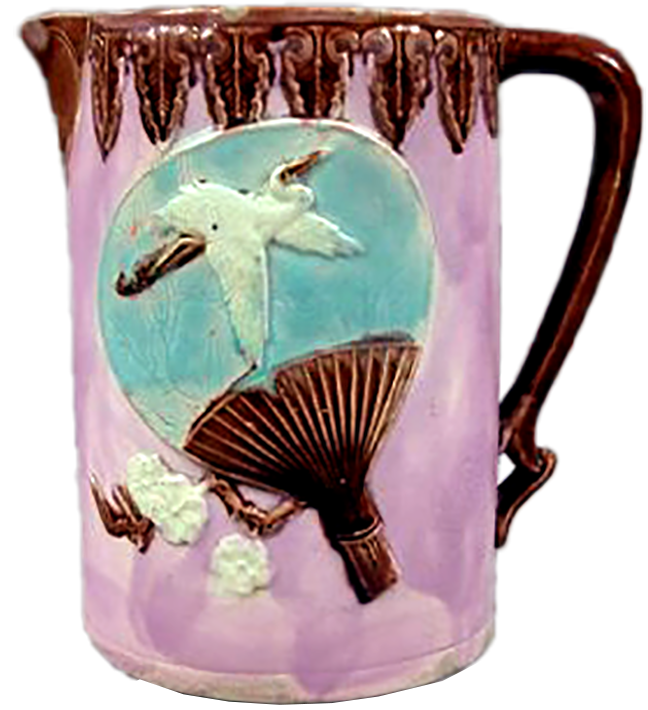
Shorter & Boulton majolica Fan pitcher

James Wardle and Company was one of the earliest English companies to jump on the majolica bandwagon. They did a huge business in the United States largely on their Asian influenced wares. Like Banks and Thorley, they did a big business in their Japanese bamboo themed majolica, but the pattern we see most commonly is their Fan pattern wares.
Wardle majolica Fan bread tray
The Wardle bread platter was later copied by the Arsenal Pottery
Wardle majolica Fan tea set
Wardle majolica fan tray
Wardle majolica Fan tray
Wardle majolica Fan jug
Wardle majolica Fan mustache cup

Shorter and Boulton also did a large business in majolica in the US. Their work is almost always unmarked and sometimes attributed to Fielding but the craftsmanship was not as fine as Fielding.

Shorter & Boulton majolica Fan tea kettle
Shorter & Boulton majolica Fan teapot
Shorter & Boulton majolica Fan plate
Shorter & Boulton majolica Fan mustache cup & saucer
Shorter & Boulton majolica Fan cup & saucer
Shorter & Boulton majolica Fan humidor
Shorter & Boulton majolica Fan plate

Both of these manufacturer's wares are easily found in the US and generally quite reasonable. Plates sell in the $50-$200 range depending on size and color and pitchers sell in the $75-$250 range also depending on size and color. Platters sell in the $150-$250 range.

Wednesday, August 4, 2010

Japonisme: The Influence of Asian Art on Majolica Iconography

Fielding majolica umbrella/cane stand

When I was first introduced to majolica, certain patterns just completely confused me. I had little knowledge of antiques or the history of the decorative arts aside from a preliminary art history class I had in college. Some of the things I saw just made no sense from a visual or aesthetic point of view.

Wedgwood majolica Grosvenor pattern
Wedgwood majolica Grosvenor pattern

Wedgwood majolica Argenta St. Louis salmon platter

Wedgwood majolica Lincoln plate

From school I knew of the important influence of Japanese woodcuts on the Impressionists and how it ultimately let to the flattening of perspective that gave us modernism, but I knew nothing about how it impacted other aspects of design, like the artisans and craftsmen who produced the everyday things we use in our lives. As I saw more majolica I realized how important an influence it did have on Western art and it made me want to learn more.

Longchamp majolica fan plate

When the doors of Japan were opened to the West in 1853 an entirely new approach to art came with it. The Europeans were fascinated by these strange and new ways of seeing that the Japanese had as part of their culture. As more Japanese art flooded the West the combination of the Western aesthetic and the Asian one created a new style entirely, that of Japonaiserie. This strange new style was neither European nor Asian but a strange combination of the two. By the 1870's Japanese motifs were finding their way on to everything we saw and touched: china, furniture, cutlery, ephemera, glass and of course majolica. In Japanese art these things had specific meanings that spoke to the viewer but to the English and French who absorbed all this they were simply exotica.

Asian design from the Minton pattern books

Shorter & Boulton majolica pitcher

Shorter & Boulton majolica fan tray

Asian stylized basket weaves, like the one show on the top of this pitcher, found their way on to all sorts of items. Cherry blossoms, bamboo and plum blossoms all found their way to european designs as well. Waterfowl like cranes and herons represented bravery and good fortune to the Japanese but to Europeans they were simply elegant birds.

Wedgwood majolica crane jardiniere
Holdcroft majolica crane umbrella/cane stand

The chrysanthemum was revered for its medicinal properties in Japan and represented endurance and integrity but in European majolica it becomes an unrecognizable asian motif. (Yes, those are stylized chrysanthemums on the Wedgwood St. Louis butter pat and platter and the Lincoln dessert dish below! I should add that the stylized Japanese pine looks very similar, but are usually attached to branches in Japanese art which these are not.)

Wedgwood St. Louis majolica butter pat

Wedgwood majolica St. Louis platter

Wedgwood majolica Lincoln plate

So many images adapted from the Japanese, all of them beautiful and fascinating in their own way, but among the most important to majolica manufacturers was the fan.

Fielding majolica Fan cake tray

Representing such diverse things as family and religious figures, fans were a common motif in Japanese art. Folding fans had one meaning and rigid fans another but to the Europeans they were all the same. Fans  began to appear everywhere!

Fan design from the Minton pattern books

George Jones majolica fan butter pat


Holdcroft majolica fan butter pat


Villeroy & Boch majolica fan plate


Choisy-le-Roi majolica wall pocket


In fact, fans became such an integral component to the majolica of five manufacturers, Fielding, Wedgwood, Shorter & Boulton, Willets and Wardle, that it's impossible to think of their majolica without including something with fans on it.

Over the next few days I'm going to discuss each of these companies and their beautiful fan-themed wares.

* This article has been updated since it was first posted.