A look at the design, market and legacy of Victorian pottery

Sunday, July 31, 2011

Green Majolica Pottery


Sarreguemines oyster plates

One of the simplest and most elegant ways of displaying majolica is by collecting all green majolica.

Green glazed pottery has been a staple of households for 250 years. It is a classic English country look that is often paired with painted or natural country pine furniture by decorators.


Wedgwood has been the leader in the production of this green dinnerware from the start. Beginning from the time of the Wedgwood Whieldon partnership, green glazed earthenware has provided an elegant colorful background for the service of food. Once the manufacture of majolica began in earnest after 1851, potteries from Minton to the smallest independent pottery began the production of this ware. As a result, there is plenty of green majolica to pick from.

Minton majolica plate
James Reed green majolica plate. 
Also made by Hope & Carter, Burselem
Pattern originated with Samuel Alcock but 
was copied by many others
Hope & Carter, Burslem majolica green plate 
Hope & Carter  green majolica begonia plate
Adams & Bromley majolica pond lily plate. 
Also made by Minton
Adams & Bromley majolica grape leaf plate
Wedgwood majolica plate
Wedgwood majolica Leafage platter
Wedgwood majolica grape leaf plate

Wedgwood & Co. majolica plate

Copeland majolica leaf plate
Wedgwood majolica sunflower plate

Wedgwood majolica green plate
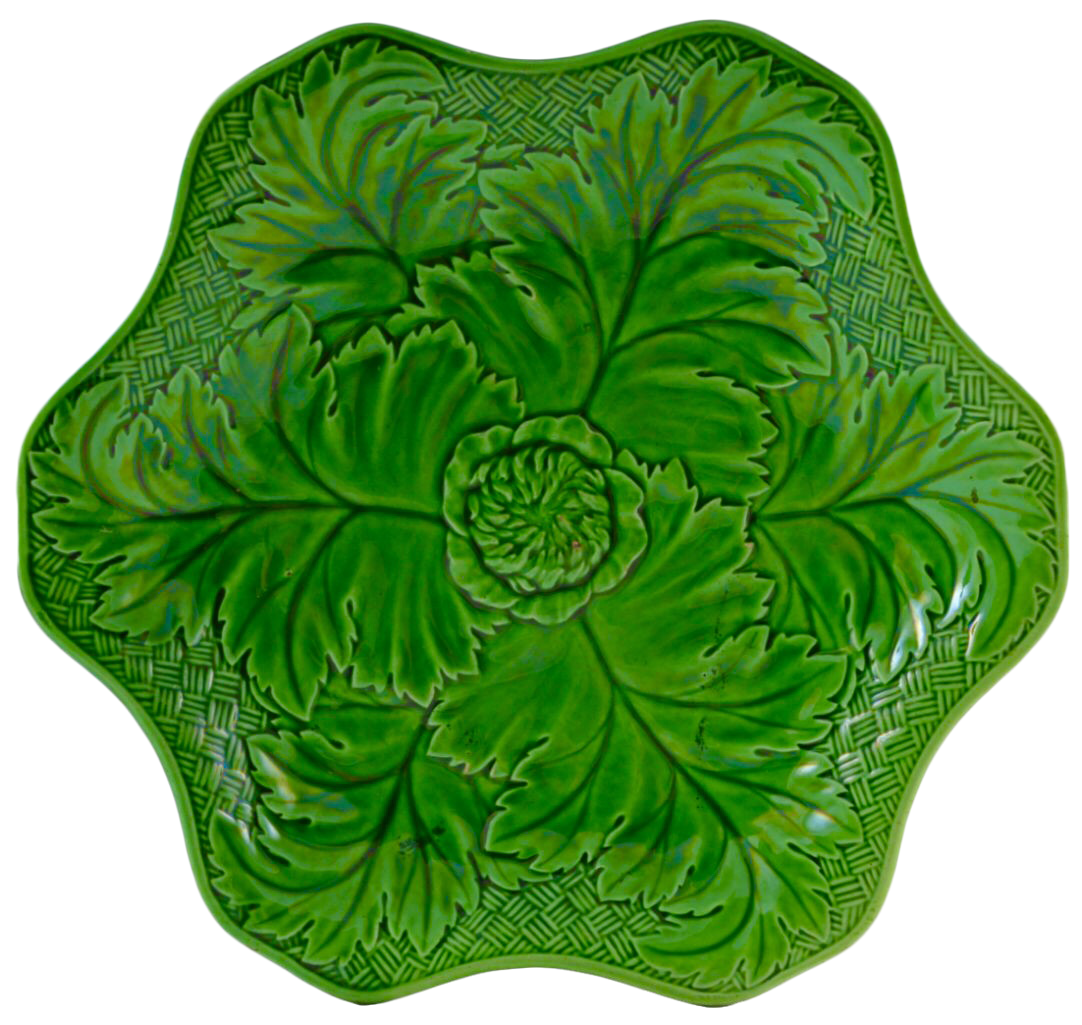
Wedgwood majolica green foxglove plate
Wedgwood majolica green plate

Wedgwood green majolica soup tureen

It has proven so popular it remains in production today.

Twentieth century Wedgwood grape plate 

Mixed in with regular majolica it adds a lovely counterpoint to the bright colors in the majolica pieces. As an accent in rooms with porcelain or other types of pottery it adds a beautiful bit of color.


It was meant for everyday use and was inexpensive when it was new. It remains reasonably priced today with most pieces selling under $100.


So the next time someone tells you that they love majolica but can't afford the prices, steer them towards green majolica. It's an inexpensive way of collecting majolica that still looks like a million bucks!

For more on Wedgwood's green majolica go here.

This post has been updated since it was first posted

Friday, July 22, 2011

The Case for Cuspidors


Cuspidors have an image problem.

When I was an antiques dealer traveling around the country I was surprised at the large number of majolica collectors who simply wanted nothing to do with cuspidors. Maybe it's the unfortunately vivid alternate name of "spittoon" that puts people off. It certainly can't be the pedigree. Cuspidors were made by virtually every majolica manufacturer from Minton to the tiniest independent pottery. It certainly can't be the design. Cuspidors come in every color and shape imaginable, from the elegant George Jones tortoise to the humble but beautiful Sunflower of Griffen, Smith and Company. No, it simply has to be the original intended usage, as a container for spittle or chewing tobacco. I can think of no other ceramic, save for the chamber pot, that has this problem.

According to Wikipedia, the golden age of cuspidors was from 1840 to 1918 though they've been in use in Asia for centuries. It took the flu epidemic of 1918 to put an end to its use by genteel society. Since this was also roughly the golden age of majolica manufacture it just makes sense that they would have been made in majolica as well as other materials.
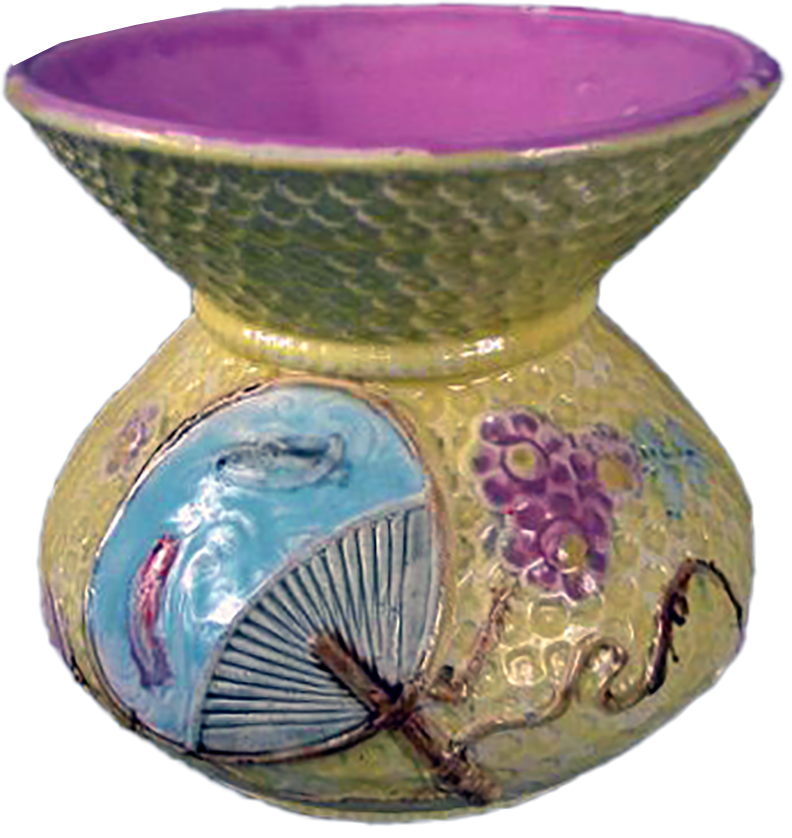
While majolica collectors spurn cuspidors, they are adored by decorators. I can't tell you how many decorator rooms I have been through that feature at least one cuspidor as a flower vase. The large, squat shape of these containers are perfect for table centerpieces, allowing for plenty of flowers while not blocking the view of the guests on the opposite side of the table. Indeed, it is a wonderful vessel for this use though I would place a glass liner inside to protect it.

All that being said, there are some wonderful cuspidors  out there.

Forester Rose & Trellis cuspidor
Wardle Fan majolica cuspidor
Holdcroft majolica water lily cuspidor
Majolica water lily cuspidor
Majolica frog cuspidor
Majolica fish cuspidor

Shorter & Boulton Shell cuspidor 


Samuel Lear majolica Sunflower cuspidor
Wardle/Lear majolica water lily cuspidor
McCoy Carnelian majolica cuspidor c.1904
Wild rose majolica cuspidor
Wardle maajolica Sunflower cuspidor 
Etruscan Majolica Shell cuspidor
Majolica pineapple cuspidor


Etruscan Majolica Lily cuspidor
Etruscan Majolica Sunflower cuspidor
Wardle & Co. majolica cuspidor 
Arsenal Pottery majolica cuspidor 
Adams & Bromley majolica cuspidor
Belfield Pottery majolica cuspidor 


Forester majolica cuspidor
Wardle Fern & Bamboo cuspidor

Forester majolica cuspidor 


George Jones tortoise cuspidor
. Lift off the shell and the hole for the spittle in underneath.

Etruscan Majolica Pineapple cuspidor 


Wouldn't one of these look great on your dinner table filled with fresh flowers?

*This post has been updated since it was first published.