A look at the design, market and legacy of Victorian pottery

Saturday, February 21, 2015

Majolica Jardinieres and Cachepots

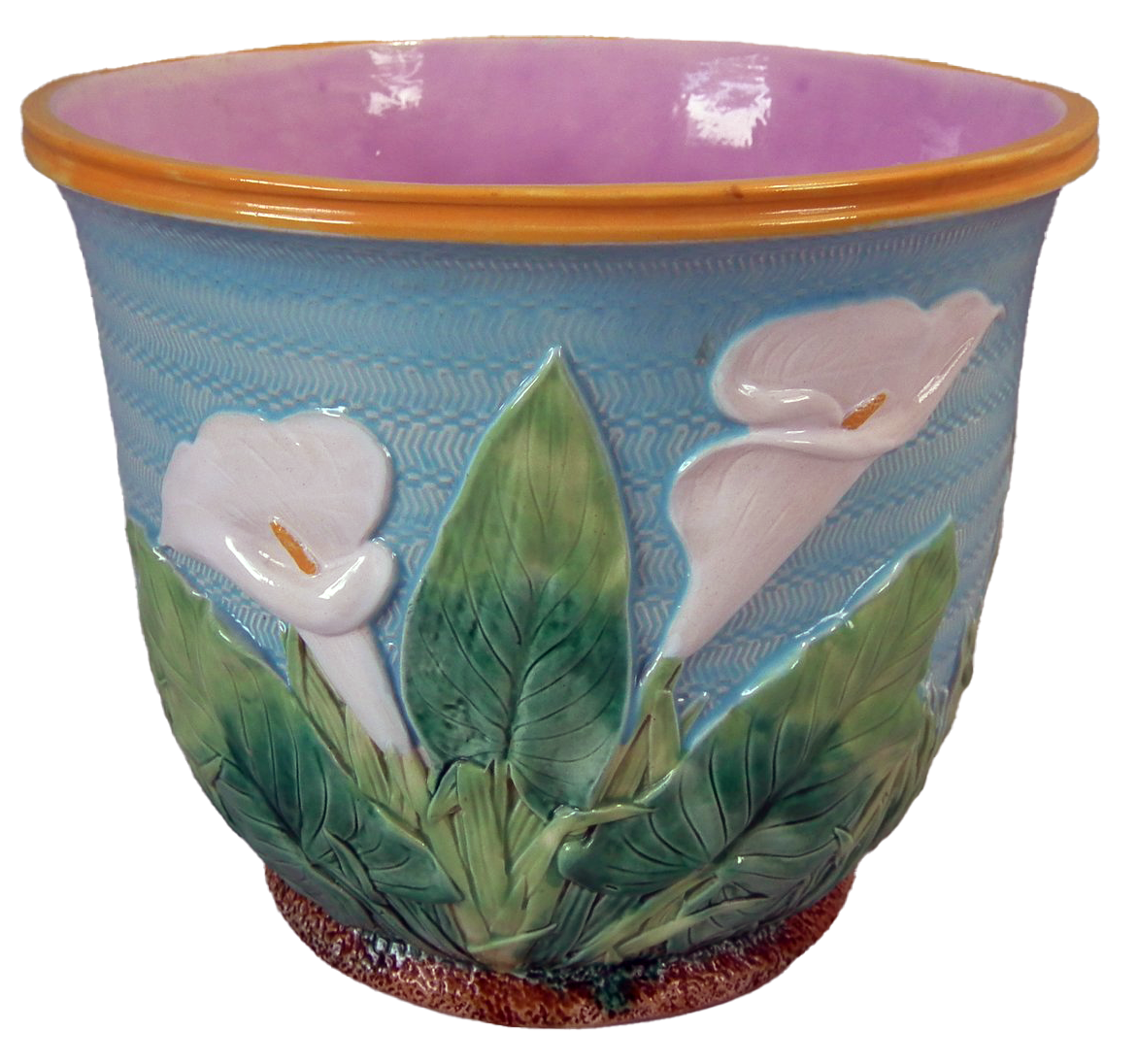
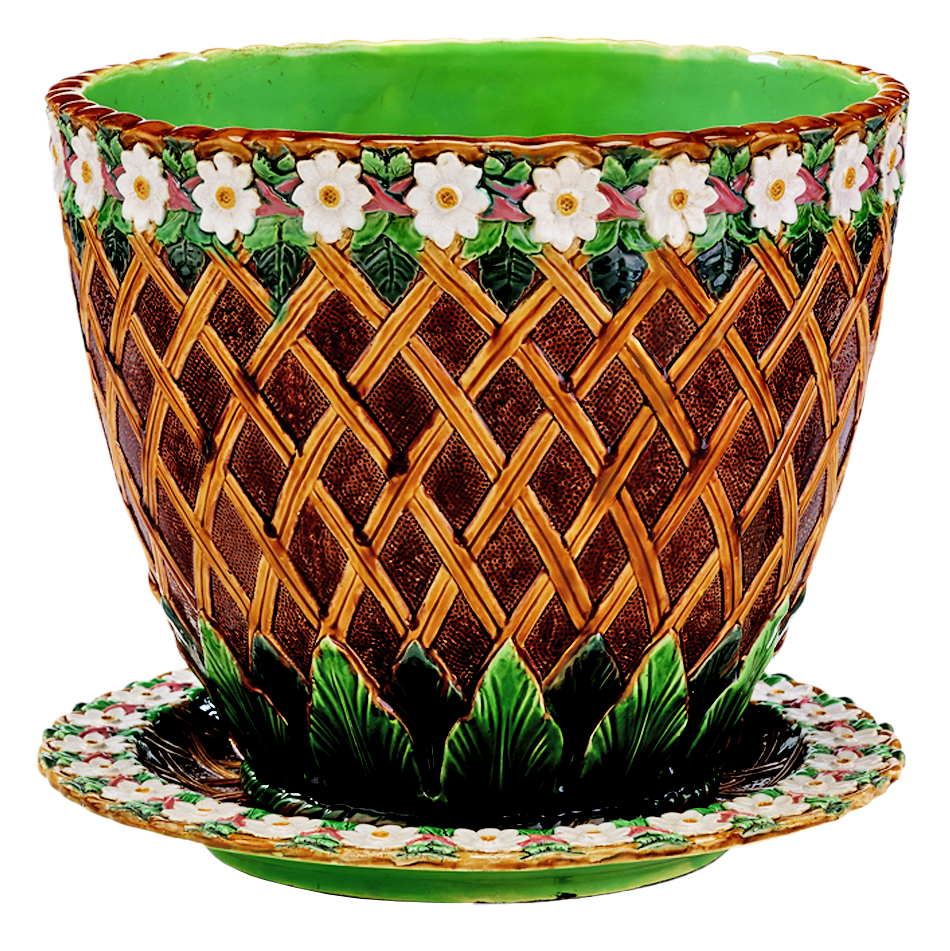
From Wikipedia: Jardinière is a French word, from the feminine form of "gardener"; A flower box, a receptacle (usually a ceramic pot or urn) or more rarely a stand upon which, or into which, plants may be placed. (The French themselves refer to tabletop versions of such receptacles as cachepots.) Jardinières tend to be highly decorative and are sometimes used as garden accent elements for large plants and for raised culinary and herb gardens.

The history of majolica jardinières and cachepots goes back to the origin of the pottery itself. There are probably more majolica designs for jardinières than any other majolica form. Majolica was ideal for use in solariums and greenhouses. Its use has continued many years after majolica has ceased to be popular for other uses. Even today you can go into Walmart or Home Depot and buy a flower pot in the contemporary equivalent of a majolica ceramic glaze.

Lets take a look at some Victorian examples:
From Minton...

Tole and majolica tile jardiniere attributed to Minton 
Image from the Minton pattern books
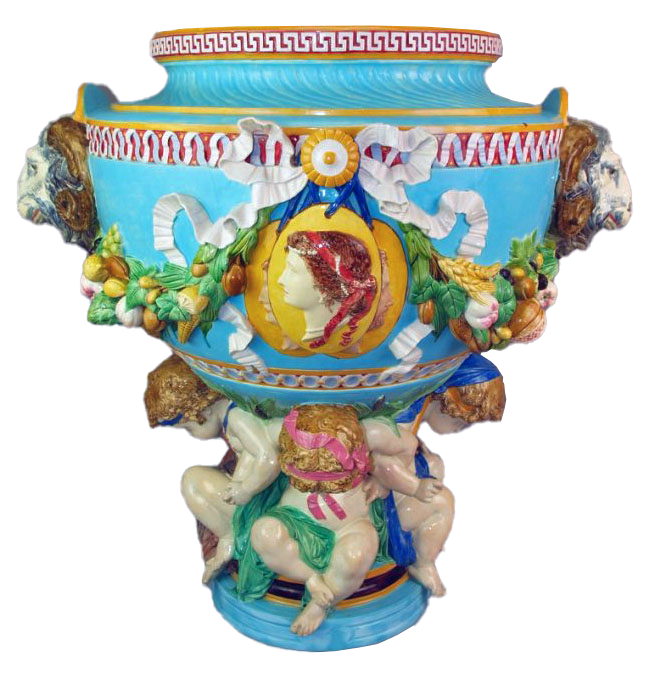
Minton majolica jardiniere designed by Baron Carlo Marochetti

Minton majolica jardiniere designed by architect Gottfried Semper
Minton majolica jardiniere designed by Christopher Dresser
Minton majolica cistern or jardiniere designed by Baron Carlo Marochetti
Minton Thorwaldsen jardiniere

From George Jones...

George Jones majolica Stephanotis oval flower pot
George Jones majolica Stephanotis round flower pot
Made by both George Jones and Holdcroft
The Massier family...


Wedgwood..

Dolphin jardiniere from the Wedgwood pattern books
Wedgwood majolica jardiniere designed by Christopher Dresser
Drawing for a wedgwood dragon jardiniere from 
the Wedgwood pattern books
Wedgwood majolica Luther jardiniere
Wedgwood majolica Old English jardiniere
Wedgwood Lion's Head jardiniere
Wedgwood majolica Lowell jardiniere
For Wedgwood by Christopher Dresser
Wedgwood Kate Greenaway jardiniere
Wedgwood Grosvenor jardiniere
Wedgwood majolica Fan jardiniere
Wedgwood majolica aesthetic jardiniere
Forester, Holdcroft, Dressler and Adams & Co....

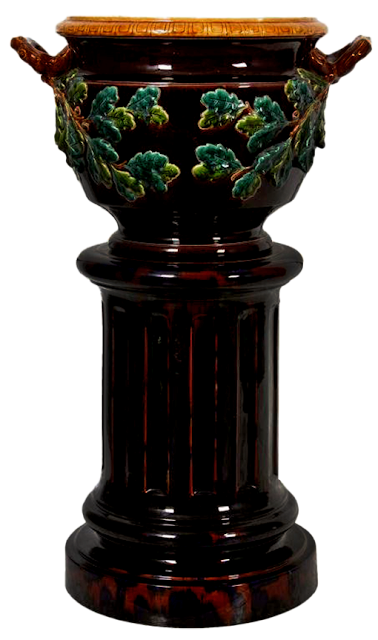
Forester jardiniere and pedestal
Forester
Forester
Forester
Forester majolica dragon heads jardiniere
Holdcroft majolica fish jardiniere
Holdcroft
Holdcroft majolica parrot jardiniere
Holdcroft garland jardiniere
Holdcroft majolica peacock jardiniere
Holdcroft

Holdcroft
Holdcroft majolica swan jardiniere
Holdcroft majolica bird and ivy jardiniere
Holdcroft majolica square jardiniere
Holdcroft majolica floral jardiniere
Holdcroft majolica morning glory jardiniere
Holdcroft majolica ram's head jardiniere
Holdcroft majolica water lily jardiniere
Bretby majolica jardiniere and pedestal 
Julius Dressler

Julius Dressler 

Adams & Company
Adams & Bromley
Adams & Bromley

Schiller, Copeland, Lonitz, Théodore Deck, Royal Art Pottery, and Brown, Westhead Moore...

Schiller & Son
Copeland
Copeland majolica primrose jardiniere
Copeland
Copeland square majolica jardiniere
Copeland majolica jardiniere
Royal Art Pottery New Leaf jardiniere and pedestal
Royal Worcester
Skey Wilnecoate Ware
Lonitz
Théodore Deck


Onnaing, Orchies, Sergent, Poet Laval, Thulin and Sarreguemines...

Orchies catalog page showing some of their jardinieres.
Onnaing catalog page showing some of their jardinieres
Onnaing
Onnaing
Orchies majolica jardiniere 
Poet Laval floral jardiniere
Thulin majolica jardiniere
Onnaing majolica jardiniere 
Onnaing majolica jardiniere 
Onnaing majolica jardiniere
Orchies

Sarreguemines 
Sarreguemines 
Sarreguemines 
Sarreguemines 
Sarreguemines 
Orchies catalog page
Sergent majolica jardiniere
... and Griffen Smith & Company.

There are so many more designs that we couldn't possibly post them all. Still, this gives an idea of the width and breadth of the patterns produced as jardinières.


This post has been updated since it was first published.


Friday, February 20, 2015

The Art of Majolica: John Harold Wood

We'll be the first to admit that we've never heard of painter John Harold Wood. All we've been able to uncover about him is that he lived from 1890 to 1965. The best that we can surmise is that he was an enthusiastic amateur. That would certainly describe the quality of Daffodils in a Majolica Jug, a canvas we discovered online.


While colorful the picture doesn't illustrate the most deft use of painterly technique or composition. Still it is a quite pleasant painting.

For the majolica collector the jug pictured is a well known Wedgwood majolica pitcher.


We've always liked this particular design. The use of different forms of rigid basket construction to put together the barrel shaped jug adds a nice contrast to the elegant natural cattails that encircle it.

Regardless of the provenance of the painting in question we always enjoy seeing a piece of majolica we recognize in an artist's painting. We would be interested in hearing if he did other paintings using this jug.

Thursday, February 19, 2015

Majolica in the Movies: Pillow Talk


We were watching the wonderful Doris Day/Rock Hudson vehicle Pillow Talk on TV the other day and were amused by the appearance of a piece of majolica in the film.

Rock Hudson's character, womanizer Brad Allen, shares a party line (when was the last time you thought about party lines?) with decorator Jan Morrow played by Doris Day. Fighting for time on the party line makes them dislike each other though they have never met. When Brad finally gets a look at Jan he decides he needs to get to know her. Brad takes an assumed name and attempts to woo Jan as cowboy Rex Stetson. Jan falls in love with Rex. However once she discovers Rex is actually her obnoxious party line Brad, she refuses to have anything more to do with him. 

Meanwhile Rex has fallen for her hard and is willing to give up his womanizing ways to marry her. Only problem is that she won't talk to him, let alone marry him. He decides to hire her as his decorator to break the ice. Jan decides to teach Brad a lesson for fooling her by redecorating his apartment in the most vulgar and tasteless way she knows how. This is where we find the majolica.

In 1959 when this movie was filmed, majolica was still considered the most vulgar form of pottery imaginable. It was totally at odds with the sleek Danish Modern style popular at the time. In this redecorated apartment Jan uses a boldly colored majolica jardiniere and pedestal and sets it up right besides Brad's bed. We can't say we recognize the pattern but it looks like some of the work Royal Doulton did in the first part of the Twentieth Century. You can see it in the picture below.


To be honest we were rather surprised that this was the only piece of majolica included considering. Among the other wild pieces in the new "bachelor pad" is a two headed turtle and a large wally bird vase (or copy) by the Martin Brothers. Today, a wally bird in that size would sell for tens of thousands of dollars.


Needless to say it all works out in the end and Jan and Brad get married. Still, the movie is an interesting and amusing window into the past and at how time changes our perception of beauty.

To view the Pillow Talk trailer go here.

Thursday, November 27, 2014

The Latest Majolica Reproductions

The main reason I do these posts on majolica reproductions is not only because they are popular, but to make somewhat less experienced collectors aware of some of the deception available in the market. None of these are very convincing and most of them wouldn't fool anyone, still I like to keep everyone aware of what's out there.

Reproduction game dish
Reproduction George Jones strawberry server
Forester rose and rope reproduction 
Reproduction Etruscan cauliflower plate
Reproduction Holdcroft teapot
Reproduction Wedgwood jug
Reproduction Etruscan jug
Reproduction Minton center
Reproduction Minton game dish
Wedgwood Fan jug reproduction

Thursday, October 2, 2014

Sculpture Victorious: Art in an Age of Invention, 1837–1901


We found ourselves making the two hour sojourn to New Haven recently to view two of the finest examples of majolica ever potted. The Yale Center for British Art is hosting an exhibition of sculpture during the reign of Queen Victoria, Sculpture Victorious: Art in the Age of Invention, 1837-1901. Among the 135 objects of marble and bronze included in the show are two monumental pieces of majolica: one of the Thomas Goode Minton elephants and the Minton peacock.

The elephant, a seven foot tall masterpiece of majolica, is one of two commissioned by Thomas Goode for the 1889 Exhibition Universelle in Paris, the same exhibition that brought the world the Eiffel Tower. They were modeled by Thomas Longmore and John Hénk for Minton & Co.


The elephants appeared to great acclaim at the show after which they were placed in the Thomas Goode shop window in Mayfair. There they have stood ever since. 

A masterpiece of decorative art I believe this is the first time one of the elephants has been shown in the United States. Seven feet tall including howdah, the gilded majolica elephant stands on a base of carved ebony and majolica tile. The detail is astonishing.
Minton majolica elephant with howdah
Minton majolica elephant with howdah detail

In addition to the elephant in the show, there is also an example of the Minton majolica peacock which is on loan from an American collector. Modeled in 1873 by sculptor Paul Comolera it predates the elephant by about 15 years.

Minton majolica peacock
Minton Peacock detail of tail

Though we were not permitted to photograph the peacock we have written about it several times before: here, and here, and here. Only a handful are known to survive so having an opportunity to see one up close was a rare treat.

The show also includes extraordinary works in precious metals such as The Eglinton Trophy and The First Class Badge of the Order of Victoria and Albert.

The First Class Badge of the Order of Victoria and Albert

In all it is a lovely show embracing sculpture in a wide variety of media.

It runs through November 30 at Yale at which time it will move to the Tate gallery in Britain. There it will run from February 25 to May 25, 2015.