A look at the design, market and legacy of Victorian pottery

Showing posts with label Ebay. Show all posts

Saturday, February 10, 2024

Finding the Real Value of Your Antiques

Without a doubt the most common question I am asked as an antique dealer is, “How much is my antique worth?”

It has always been my practice to not discuss values in this blog because of the variables involved in pricing an individual item, but there are numerous resources one can use to give you a ballpark idea of what the value is of your particular item. 

While this post is on a pottery blog these rules can guide anyone interested in selling an item of any nature on the secondary market.

Condition, Color and Craftsmanship

Three very important criteria to consider when evaluating the value of a piece is in the 3 C’s: condition, whether it is repaired or as originally issued; its color, particularly when dealing with pottery; and its craftsmanship, or how well it was made. More than most other factors these will determine the price of a piece. 

To these we can add a fourth C–collectibility. Collectibility in not necessarily determined by rarity, though it sometimes is, but more on desirability. With many very rare antiques the price factor doesn't really come into play because there is little demand for them. 

For more on desirability go here. for more on the importance of color go here.

Price Guides

The most obvious way to find out the value of an item is through a printed price guide. Many books on antiques specialize in assigning values to particular items, however there are many limitations to printed guides like this. The market for antiques is constantly fluctuating. Reruns of the PBS show Antiques Roadshow illustrate a good example of this. Old episodes feature adjusted values at the conclusion of appraisals to allow for how the market has changed in the years between the original airing and a more recent appraisal. Intangibles like fad, desirability and the stock market can all affect the prices of antiques. This gives the printed price guide a built in obsolescence.


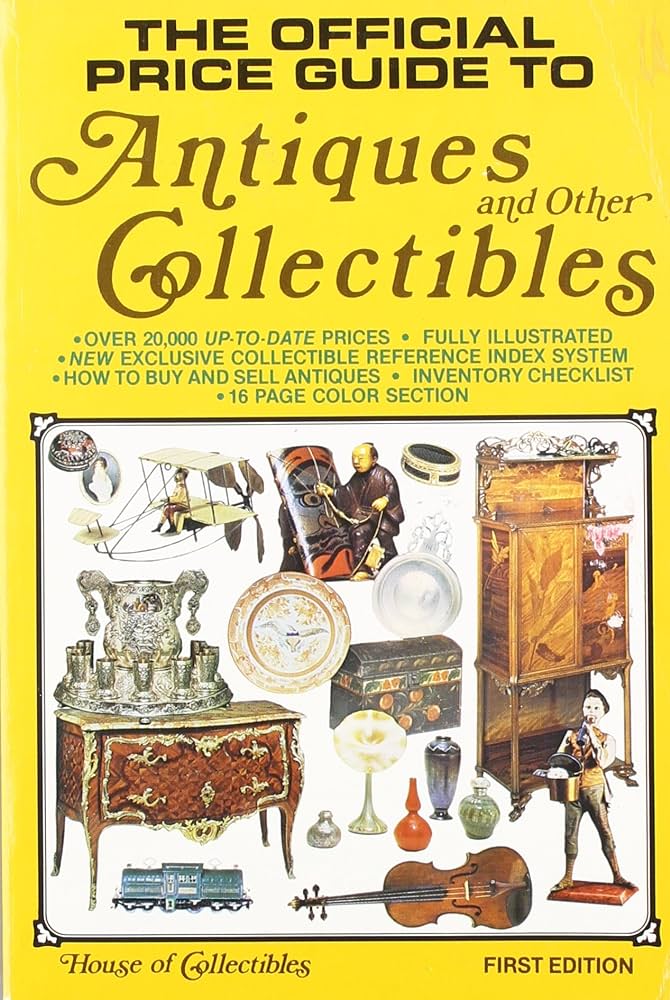

Certain companies that specialize in these guides like Warman’s Antiques, Miller's Antiques and Kovel’s Antiques take advantage of this to keep people interested in buying updated guides year after year. Before the invention of the internet these were the only venue for finding this type of information. This is probably the fastest way of getting a price, but to my mind not a very dependable method of finding the real value of your item. 

Television


Leigh Keno appraises an item with a guest on Antiques Roadshow.

Appraiser Lark Mason and a guest on Antiques Roadshow

Before I move on, one word of advice when viewing programs like Antiques Roadshow. Appraisers frequently inflate the value of an item for the sake of drama on these shows. Whenever you see an appraiser offer an insurance value of an item it is often double the actual sale value of a piece. This is because insurance values are based on replacing an irreplaceable item retail, which is generally a 100% markup over its sale value. These programs are meant as entertainment, not a guide on valuing your antiques. For more on my thoughts on Antiques Roadshow go here

Retail Antiques Stores and Shows

This method involves comparing your item to one found in a local antique store or at a local antiques show. This method of pricing your item is more dependable than the printed guide because it gives a good indication of more current values than a printed price guide, but there are built in limitations to this as well. Dealers of antiques have varying levels of experience in evaluating the price of any particular item. If the dealer you are consulting has only a general knowledge of antiques, their expertise in a particular field is likely limited. They may well price an item based on a price guide they bought five years ago or something similar they owned ten years ago. No one can know everything, so they do their best based on their own resources and experience. Unless you are dealing with a dealer who specializes in a particular field you are likely to get an undependable price.


Collectors and Specialty Dealers

Collectors and dealers of particular fields of antiques are usually quite attuned to the market value of the items they buy and sell. Should you find one willing to generously share this knowledge with you, you can often depend on their advice, The biggest problem here is that most collectors and dealers keep their knowledge close to the vest and are unwilling to share this information with anyone lest they miss out of a good bargain on a piece they are interested in. Many dealers’ entire livelihood is dependent on the ignorance of sellers. The advice here is if you know someone with this knowledge who is willing to share it, you can depend on it, PROVIDING they know you will not sell them the item in discussion.

Auctions and Online Resources

Considering the fluid nature of the market, auctions both in person and on the web are usually the most dependable means of finding the correct value for your item. Online auction sites like eBay and LiveAuctions are an excellent resource for finding the value of your piece. A search of past auction results will bring up a number of examples similar or identical to your item. 

The more recent the sale, the more reliable the result, If the item is sold through a general sale, the retail price is generally 50%-100% above the auction value. If it is a specialty auction, the value realized is usually closer to retail.

You should also consider the auction venue when considering prices. International premium auction houses like Sotheby’s, Christie’s and Doyle can usually command prices far above what the general value may be of a particular item. This has as much to do with their advertising resources and reputation as anything else. They usually only accept items above a certain price point and charge massive auction fees, sometimes as high as 60%, of the final auction value.

For more on eBay go here, For more on buying at auction go here.


Conclusion 

Selling anything on the secondary market is a minefield full of traps. The more educated you become in the market of the item you are selling, the more likely you will be in concluding a fair, satisfying and successful sale.

Saturday, March 24, 2012

False Advertising Pet Peeves

I spend some time each week cruising the listings of eBay. I love seeing the variety of majolica available, noting the prices, and looking for common pieces when they appear in unusual glaze combinations. One of the things I DON'T like about eBay is the wide number of dealers who place false claims in their listing titles just to get your attention. Here are some of my listing pet peeves.

The one that drives me the most nuts are the dealers who will describe their piece in the title and follow it with "George Jones?" or "Minton?". Where it is true some dealers genuinely don't know what they have, others know they have an incredibly mundane piece of majolica and feel that the only way they can attract attention to it is to mention a brand name that is in demand. This practice probably peaked a few years ago so you don't see it as often as you used to but it still shows up.


Another trick that eBay dealers use to get attention to their listings is to place certain key words in their listing title because they know it will bring their listing up on general searches. Aside from the names of major majolica manufacturers, who are always included in such listings, colors like "cobalt" are made to sound more important than they really are in the piece. I can't tell you how many listings succeeded in grabbing my attention by advertising the piece as being cobalt, only to discover after looking at the picture that the piece was some other color with a tiny bit of blue used in trim. Such listings infuriate me. Yes, the dealer was being honest in the listing (sort of) and yes they were successful in their intention of having me read their listing, but to what end? If I'm looking for a piece in cobalt, a green piece with blue trim isn't going to make me want it any more than if I had seen the piece in a thumbnail and thought it was just green. To my way of thinking this practice smells of desperation. As the old saying goes, "desperation stinks."


Still another thing that bugs me is the liberal use of the word "vintage." Online "vintage" is eBay speak for a reproduction. Dealers of "vintage" know they can't describe the piece as being antique because clear deception is against eBay's rules and they know it's grounds for the buyer successfully receiving a refund. Describing it as "vintage" however is a bit more vague and only implies that it is antique.

An annoying term that is often used in combination with "vintage" is the phrase "fresh from an estate."  "Fresh from an estate" means nothing. Simply because something was previously owned makes no guarantee to it's age and dishonest dealers know it. I could buy something new today and die tomorrow. That would make the new object fresh from my estate. Does that make it an antique?
Another reason they use "fresh from an estate" is so they can claim ignorance about the piece. That's very convenient if the piece has been repaired or is a good reproduction.

As I've said many times before, you really need to use the utmost caution when buying online because you usually don't know the person you're buying from.
Where most listings are honest people trying to make a sale some dealers use the annonymity of the Internet to deceive people. Being aware of some of the tactics that dealers use to get your attention puts you ahead of the game.

Saturday, June 12, 2010

The Dilemma of Specialty Majolica Auctions and Ebay


When I first joined eBay in June of 1998 it was a phenomenal place to buy and sell majolica. Not only did you have access to things you'd otherwise never see, but there was a whole audience out there for things that didn't sell well in your geographic area. The prices were often great because people hadn't yet learned how to snipe auctions at the last second and you would get great deals on things. eBay’s fees were quite reasonable too.


Those things started to change when eBay decided there were too many reserve auctions so they started to charge ridiculous prices for auctions with reserves. Their auction fees continued to rise to the point where it became no longer viable for many dealers to sell there, me among them. If you're only making a 10% markup on something, why would you allow eBay to take half of that, not to mention the expense of mailing and dealing with the mail carriers?

I stopped selling majolica on eBay regularly quite a few years ago. Every once in a while I'll test the waters and throw something on there to see how the market responds but it's rarely worthwhile anymore. The only regular selling I do on eBay is for my book, Etruscan Majolica: The Majolica of Griffen, Smith & Company. That's really just for promotional purposes anyway to let people know the book is out there. I make very little profit on those eBay sales.


Regular auctions are generally more profitable than eBay but it really depends where you consign. Michael Strawser has made a nice little business out of selling majolica with Majolica Auctions. His auctions are usually well attended and well advertised. If you have something special or unique to sell, his auctions are the usually the way to go. He gets very good prices for the seller, especially for European majolica.


If you're selling American majolica, like Etruscan, or more common pieces that may have their share of bumps and bruises, you're better off putting it into a well advertised local auction. So many Etruscan collectors have complained about Strawser's attitude towards American and unmarked majolica but you really can't blame the guy. He goes where the money is. He's just making a business decision by lumping the pieces into lots. His auctions for low end and middle of the road majolica are a great place to buy if you're looking for bargains, but an awful place to sell because the pieces often bring a fraction of what they'd bring at a general sale.

It helps to know where the audience is for your majolica as well. Phoenixville pieces will sell better in Pennsylvania. Morley pieces will sell better in Ohio, and Eureka Pieces will sell better in New Jersey. It's a pretty simple formula.

The prices have come down quite a bit since 1987 because of the stock market crash but these things are cyclical. This is a good time to buy at auction but not a particularly good time to sell. The prices are bound to go up again. You just need patience.

Regardless of where you buy or sell it, DO IT!
