A look at the design, market and legacy of Victorian pottery

Tuesday, March 30, 2021

The Majolica of William Brownfield & Sons

William Brownfield entered the pottery trade in 1836 when he partnered with Noah Robinson and and John Wood to take over the Cobridge Pottery. In 1841 The Robinson family left the pottery leaving the firm to identify itself as Wood & Brownfield. In 1850 Wood retired and the pottery was named simply Brownfield. The company was a large one employing over 450 employees.

William Brownfield 1812-1873

Brownfield & Sons location at the Cobridge works outlined in red


In 1871 Brownfield exhibited his first majolica wares and brought his son William E. into the firm to become Brownfield & Son. William Brownfield died in 1873 leaving the pottery to the care of his son. In 1876 another son joined the pottery and three years later the third son joined forming Brownfield & Sons. The company continued to grow to over 600 employees through the 1880s.

Brownfield display at the1881 World Exhibition in Melbourne, Australia

Brownfield ad from May 1876

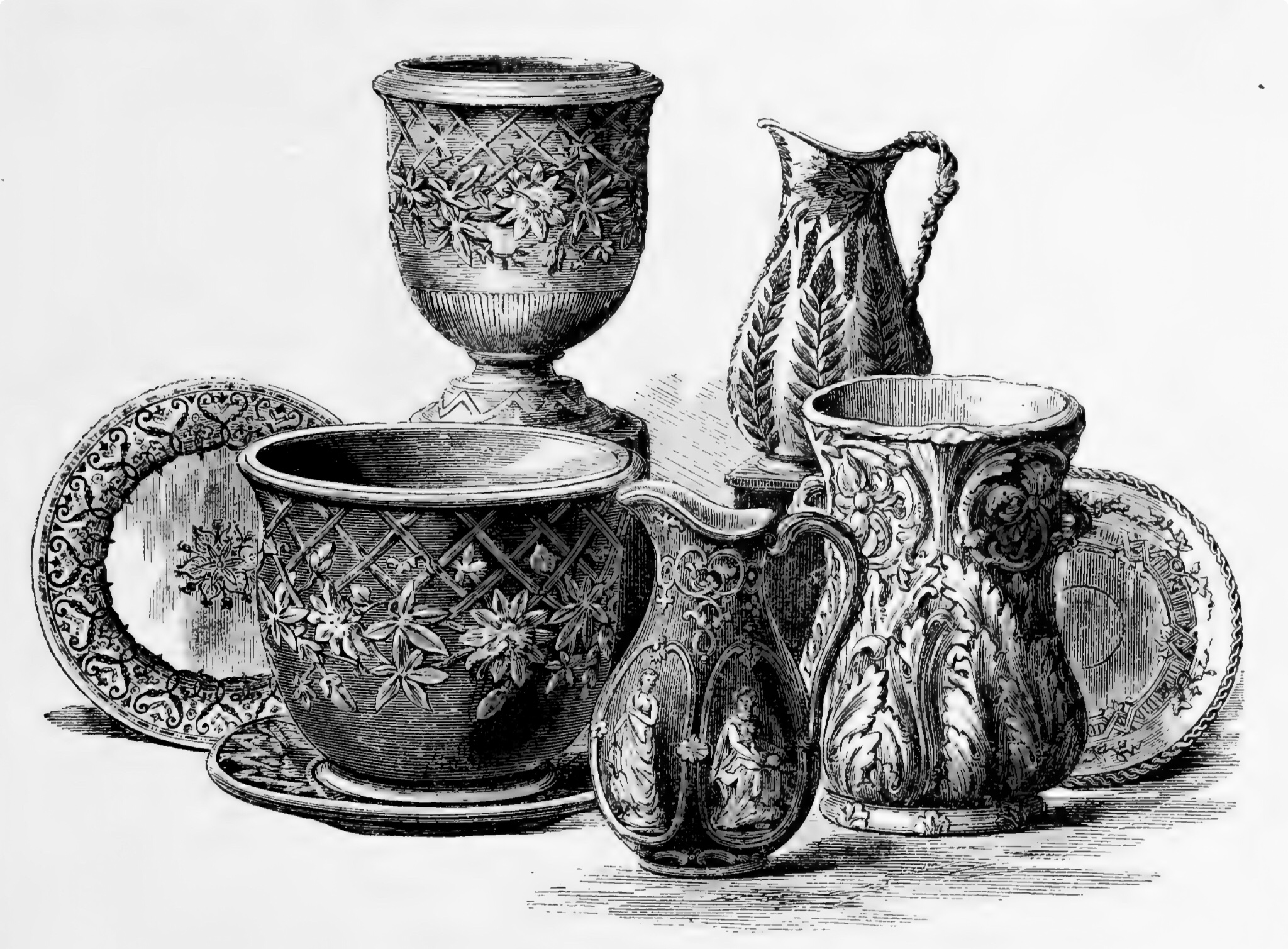
Engraving from The Ceramic Art of Great Britain (1878)

Brownfield ad January 1, 1881

Brownfield majolica ad December 1881

Brownfield ad 1906

Brownfield first exhibited majolica at the 1871 London Exhibition. Initial majolica examples include designs registered earlier and made in other bodies. 


Brownfield registered design

Brownfield majolica Chestnut cheese bell

The company worked with many of the finest modelers in the industry like Carrier-Belluse and Hughs Protât, making some of the company's work the equal of Minton.


Brownfield Face and Pigtail majolica teapot
Brownfield majolica Man and Gourd teapot
Brownfield majolica teapot

The Isle of Man teapots were a specialty order for retailer W. Broughton

Brownfield majolica Fish teapot

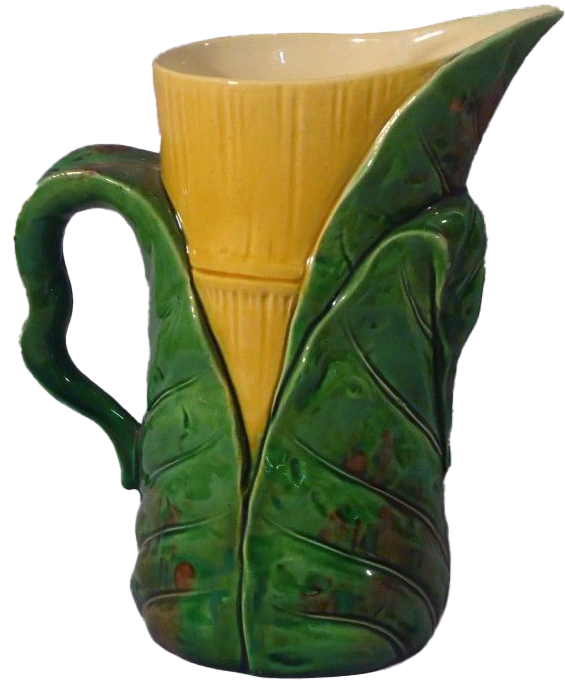
Brownfield majolica Cone teapot

Brownfield  catalog Cat and Globe Ornament, first shown in Philadelphia 1976
Brownfield majolica Cat and Grove Ornament, missing the box finial
Brownfield majolica Kittens vase. Also made as a triple flower stand (below)


Brownfield majolica fountain c.1883

Much of Brownfield majolica has a distinctive look because of the pale ochre body used by the company and also because of many of the colored glazes used which had a different character from other majolica made during this time. Interiors were often left with clear glazes that highlight the color of the body or Persian blue/cyan instead of the pink which was more common. The thick glazes used were also often opaque or translucent as opposed to the transparent glazes used by other potteries. The color combination of green, deep cadmium yellow, brown and cyan was common among Brownfield pieces along with a very deep navy, and opaque pale canary yellow that were unique to the ware. 

The similarity between the many rustic pieces created by the company implies a specialty line created and most likely marketed under a unique brand name within the company’s oeuvre.


The craftsmanship is also usually excellent putting it equal to the finest manufacturers. Designs were often copied from other manufacturers but with the distinct Brownfield glazes they took on a different character.


Attributed to Brownfield.  A variation of a Copeland design.


Brownfield Hampton majolica jug


Majolica jug attributed to Brownfield, 
a copy of a Ridgeway & Co. design


Figures often had skin tones covered with a clear glaze allowing the pale ochre body to show through.

Brownfield majolica Mama and Papa figures 
first shown in Philadelphia, 1876


Of course the company made special use platters and garden seats like other potteries. 

Brownfield majolica motto bread tray


Brownfield used several different marks in the course of their history to designate their ware but the two below are the most commonly found on majolica ware. Ink marks, which were common on other bodies, were not used.


The company was dissolved in 1892 and reorganized as the Brownfield Guild Pottery and then again in 1897 as the Brownfield Pottery Ltd. but neither was a success.The company was sold in 1900 and demolished two years later. The Myott pottery was later built on the ground occupied by the Brownfield pottery.

William Brownfield tombstone, Hanley, Stoke-on-Trent

William Brownfield tombstone


Saturday, January 30, 2021

Book Review: Majolica Mania: Transatlantic Pottery in England and the United States, 1850–1915


The catalog to the Majolica Mania exhibition has finally been released after a considerable delay due to the COVID-19 pandemic. The exhibition, which opens in September 2021, will be making stops at the Bard Graduate Center, New York; the Walters Art Museum, Baltimore; and the Potteries Museum and Art Gallery, Stoke-on-Trent.

To describe the work merely as a show catalog does a disservice to the exceptional scholarly work that the Bard Graduate Center has released. This is a major addition to the literature on majolica, one that will certainly remain the definitive work on the subject for many years.

The three volumes are masterly, well written with nicely photographed illustrations. The books are wonderful in the ground they cover which is mainly the larger English and American manufacturers and their influence on the pottery of 19th century England and America. The American section adds so much information that has previously been overlooked that it alone is worth the price of purchase, which is significant.

The catalog comes in a set of three volumes with a slip cover. While the slip cover itself is poorly designed its approach is fortunately not repeated between the covers of the books. The interior design is serviceable and easy to read. The set is substantial and printed on heavy, glazed stock. The illustrations are large and of very good quality. Sources are credited with a liberal use of footnotes.

Each of the three volumes cover different ground. Volume 1 gives an overall look at the topic from the foundation of the ware at the Minton factory to its fall from fashion 65 years later. It is divided into ten chapters dedicated to historical overview, influences and commercial manufacturing issues including plumbism which ultimately contributed to the ware being discontinued.


Volume 2, which is the largest of the three volumes, covers the work of the large English manufacturers. It is broken down into 17 chapters with each discussing the work of different manufacturers with some manufacturers covered by more than one chapter. Histories are given for each company with copious examples of facilities, style books and majolica illustrating the chapters. There are also parallels discussed between subjects which offer easy comparison. The final chapter of the volume is devoted to the work of smaller potters, though not illustrated as liberally as some of the other chapters. While some of Volume 2’s information has already seen the light of day through numerous other works on the subject, including this blog, bringing it all together in one tome makes for a excellent reference on the topic. 


I was sorry to see that a large volume of unmarked English majolica from small companies has been omitted. This does a disservice to the topic. Majolica was made in quantity by many, many manufacturers. I was hoping that the researchers for the catalog would have included more information on the smaller English companies of which so little is known. While the craftsmanship of these small companies may not have matched that of the large English companies, the output was prolific. Their designs are beautiful, clever and strongly evocative of the period. There is a list of many of these manufacturers in Victoria Bergesen’s book “Majolica: British, Continental and American Wares, 1851-1915" which show how pervasive majolica manufacture was in Great Britain. 


Volume 3 on American majolica is the strongest addition to the literature on majolica. So little has been known about American manufacturers the topic was ripe for discovery. It is divided into seven chapters which, like Volume 2, each address the work and history of a different company. 

The chapter on Carr’s New York City pottery is a revelation. Numerous examples, some from Carr’s descendants, see the light of day for the first time in 150 years. It is marvelous to see them after decades of curiosity about the company’s output.

The chapter on GSH is well done. The footnotes citing my book, “Etruscan Majolica: The definitive reference to the majolica of Griffen, Smith & Company,” are numerous and well appreciated. There are some mistakes, of course, as one might expect as in any large endeavor as this. There are modern reproduction asparagus mugs shown in Vol.3, P.58 that were never made by the company that are from the collection of the Chester County Historical Society. There is also a misidentification in one of the company photographs in Vol.3, P.47. They identify the two men in the photograph as Henry and George Griffen. The two men pictured are Henry Griffen and David Smith. That is easily discerned by looking at the earlier photograph of the factory workers on page 29 of the same volume. Also, the copy of the 1884 catalog cover shown is one from the Phoenixville Historical Society that was defaced by text added for the 1960 reprint. To see the catalog cover as it was originally printed, from my personal collection, you can reference P.126 in the most recent edition of my Etruscan book. 

In the section describing the wares of the Willets Manufacturing Company there is a vague attribution of the fan pieces in Vol.3, P.77 to Shorter & Boulton. As I have written in this blog the design was certainly by Shorter & Boulton as can be attested to the fan ice cream dish with an English registration mark that I show, but I guess I am really quibbling over minutia. It is a fine work on American majolica and one that is very welcome after so many years of general ignorance on the subject.

The back of Volume 3 is devoted to a checklist on items appearing in the exhibition, as well as a glossary, selective bibliography and information about the authors and photographic credits. There is also a complete index.

As a long time collector and dealer in the topic, I am thrilled to have such a lovely reference in my library. I’m sure I speak for all collectors in thanking the Bard Graduate Center and Walters Art Museum for such a fine set.

Published by Bard Center, Yale University Press. 1008 pages. All pages © 2020 Bard Graduate Center and Walters Art Museum

Monday, December 21, 2020

2020 Majolica Year in Review

For any number of reasons 2020 will not be remembered fondly by most people. The mass death toll brought on by the COVID-19 virus worldwide, a divisive election in the United States, unprecedented unemployment and poverty and the world on fire in an ecological environmental disaster in progress are but a few of the major events that have plagued us in the past twelve months. But 2020 will also be remembered by the majolica collector’s community for two other smaller events, closer to home: the postponement of the Bard College’s eagerly awaited Majolica Mania exhibition and the death of one of the founders of the Majolica International Society, Joan Stacke Graham. 

Joan Stacke Graham

Mrs. Graham’s passing this past March brought to an end an era in which majolica that had laid in dusty basements of museums and attics for a century, was finally brought to the light of day. Along with Dr. Marilyn Karmason, Joan authored a large, colorful book, MAJOLICA: A Complete History and Illustrated Survey, that made museums and the pottery community take serious notice of this long ignored innovation of the 19th century. She was an eager advocate for majolica’s recognition among pottery groups and museum collections and she tirelessly worked to benefit the collection community in joining the founding of both the MIS and the Karmason Photo Library for the benefit of scholars in the field. Her absence leaves a hole in the hearts of her family, friends and majolica collectors everywhere but their consolation lies in the great work she left and the glorious pottery she helped resurrect from the dust bin. Hers was a life well lived.

The second major upset for collectors in 2020 was in the delay of the long awaited Majolica Mania exhibition jointly sponsored by the Bard Graduate Center and the Walters Museum of Art in Baltimore. Originally scheduled to open in the summer of 2020 in Baltimore the show was postponed by the restrictions imposed by the COVID-19 virus. It is now scheduled to open on September 24, 2021 at the Bard Center then move to the Walter's Art Museum in March 2022. This will be the first comprehensive review of majolica on both sides of the Atlantic in the past 40 years with an advertised group of 350 exhibition examples. It will be accompanied by a liberally illustrated three volume catalog, Majolica Mania: Transatlantic Pottery in England and the United States available for purchase from the Bard Center or from Amazon in January 2021. For an overview of the show go here.

London Victorian home renovation PHOTO:©2020 Elle Decor Magazine

For collectors everywhere the year has provided no change in the lack of interest of our antiques past. As it has for the past several years the adage “if it’s brown it’s down” remains in full force among designers. Fabulous antique furniture beautifully crafted in exotic woods is bringing a tiny fraction of what it sold for fifteen years ago. Antiques older than mid-century modern are being completely ignored by younger people. Decorators who cater to high end clients have no interest in the beautiful things that adorned their parents, grandparents and great-grandparents homes. Glass, metal, and plastic are the current objects of desire with neutral walls, monochrome fittings and austerity all the rage. Of course that leaves no room for majolica with its bright colors and busy design. Once again, after forty years back in fashion, majolica is out of public favor. It's a sad state of affairs for collectors who find their collections worth less than what they were before the 2008 economic crash but all antiques go through cycles so it shouldn't surprise. Like everything tastes change and the old will become new again in time.

Epidemic bankruptcy  PHOTO: ©2020 USA TODAY

With over one and a half million people dead worldwide because of the COVID-19 virus the impact on everyday life has been dramatic. Naturally this has had a serious impact on all aspects of contemporary life. Among these is how it has affected retail sales of all kind. Bankruptcy has been the common denominator between large worldwide conglomerates and neighborhood family run businesses. Needless to say the impact on the antiques community has been equally powerful. Many antiques stores have closed permanently and antique shows cancelled causing great hardship to dealers and sellers. Online sales have increased for auctioneers and retailers savvy enough to make their inventory available to e-buyers. It's been a small light in the darkness of an otherwise dismal retail climate of 2020.

Majolica Collectors Community Group Facebook page

2020 also marked the introduction of the Majolica Collectors Community Group on Facebook where collectors, dealers and novices could come together and post photos and ideas about their shared interest. It's proven to be an excellent sounding board where shared information can enlighten all members interested enough to join.

So wiser and ever more worn we draw the year to an end. The COVID-19 vaccine and a new Presidential administration bring hope for a better new year. Styles change with the wind so the austerity of today's designs may yet change to bring antiques and majolica back into fashion. Retail sales are certain to improve. In any event enthusiasts will "beat boats against the current," in the words of F. Scott Fitzgerald, and continue to joyfully collect the marvelous, gaudy antique pottery we call majolica.

We bid you farewell 2020, and give you the goodbye that you so richly deserve.