A look at the design, market and legacy of Victorian pottery

Saturday, February 12, 2011

The Bethesda Fountain and Terrace

If you ever come to New York City one of the sights you'll want to see as a majolica collector, is the fabulous Bethesda Fountain and Terrace in Central Park.

Angel of the Waters Fountain

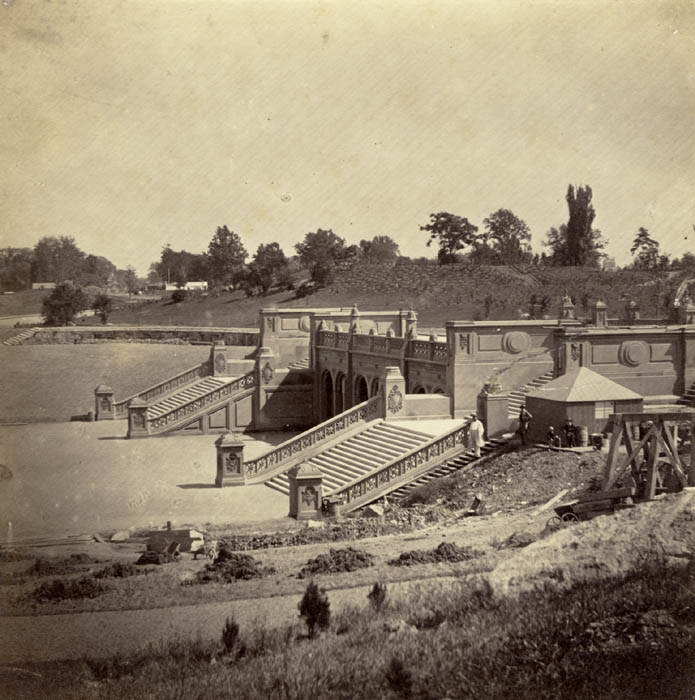
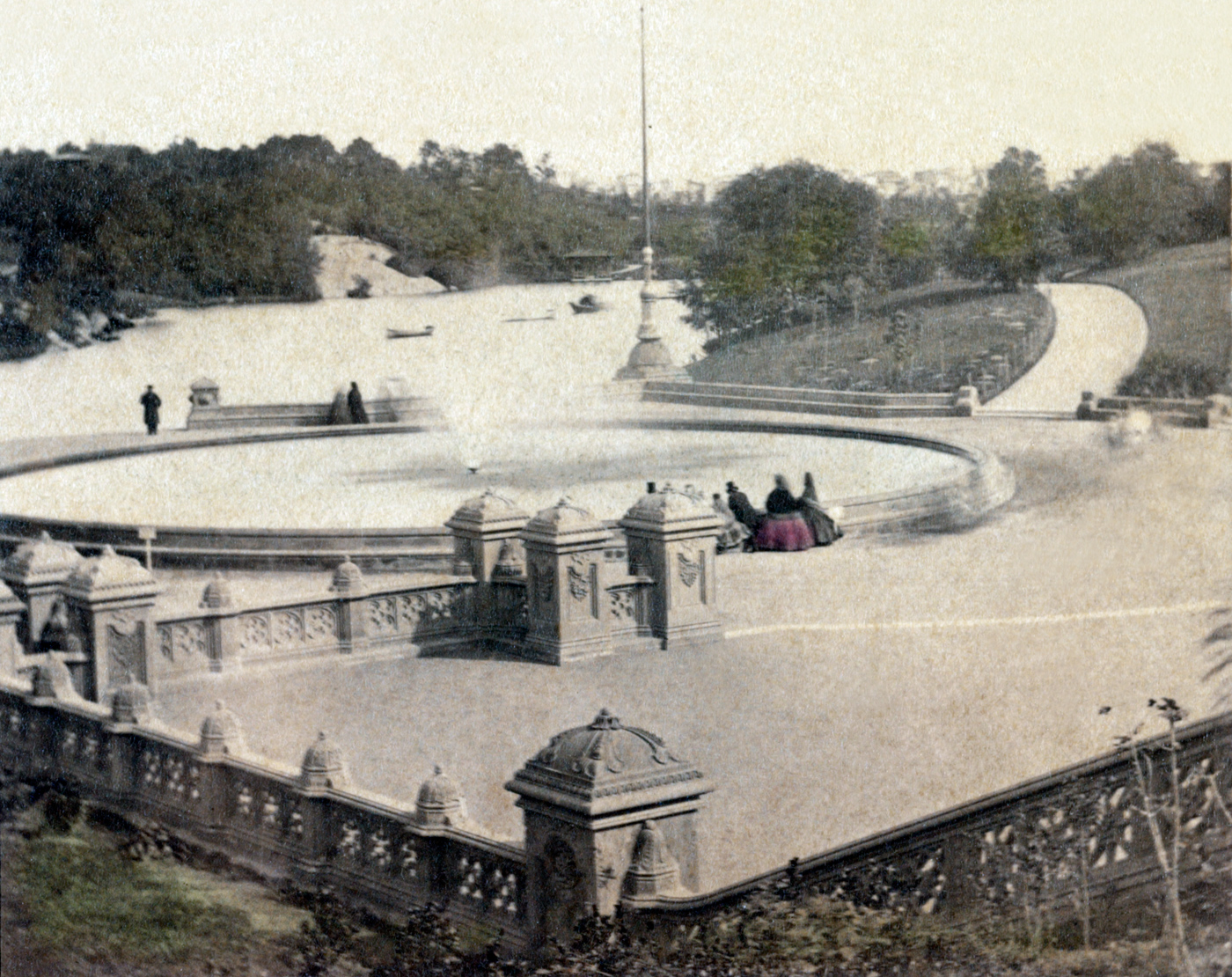
Built at the very height of the Civil War, between 1859-1864, the Water Terrace, as it was called, was designed by Calvert Vaux and Frederick Law Olmstead to commemorate the opening of the Croton Aqueduct which brought water to reservoirs in New York City. Designed to conform to the landscape of the area, the Terrace overlooks the Ramble and the Lake. The two grand staircases leading to the lower level, are adorned with carvings that depict the four seasons with detailed renderings of fruit, flowers, plants, and birds. Originally intended by Vaux to feature a fountain tribute to love, a sculpture by Emma Stebbins, the Angel of the Waters, a tribute to the biblical story of the angel Bethesda, was installed instead.

Water Terrace under construction

Water Terrace before the installation of the Angel of the Waters Fountain

Calvert Vaux

Frederick Law Olmstead

Emma Stebbins, right, and her partner 
Charlotte Cushman, left.

“For an angel went down at a certain time into the pool stirred up the water; 
then whoever stepped in first, after the stirring of the water, 
was made well of whatever disease he had” John 5:4

The ceiling of Minton tile designed by Jacob Wrey Mould, is one of the few great public examples of the use of British Minton tile in the United States.

Jacob Wrey Mould

It was installed in the terrace in 1869 and the fountain of Bethesda and the cherubs representing Temperance, Purity, Health and Peace were added in 1873. It was then that the area took on the name of the Bethesda Terrace.


The two staircases flanking the terrace.

Plaque in Bethesda Terrace

Detail from the terrace by Jacob Wrey Mould

Interior of Bethesda Terrace

Located in the middle of Central Park, the Terrace is located off west 72nd St. between the Breuer Building (the old Whitney Museum of Art) and the Frick Collection on the East side of the park and the fabulous Dakota Apartments on the West side.


The Terrace overlooks the Lake and is built of Brunswick sandstone in a Victorian mix of Romanesque, Gothic and Classical styles. It comprises two levels: the upper Terrace and the lower Terrace. The lower Terrace is where you will find the brilliant 16,000 Minton tiles that cover most of the wall and ceiling surfaces of the underground passageway. Covered in every conceivable kind of tile, primarily encaustic and majolica, the Terrace is one of the great wonders of New York City, a city full of wonders. Visit the official Central Park Web site.


A portion of the ceiling featuring Minton tiles.

We found online a couple of wonderful 360 degree panoramas that allows you to view the underground Terrace as if you were standing right in the center of it. The white arrows link to other panoramas taken within Central Park.

The first link shows the interior of the lower Terrace Arcade in daylight.


Here is another showing the underground interior Arcade in the Terrace lit up at dusk.


Now somewhat worn by time, it must have astounded visitors when it was first built. 
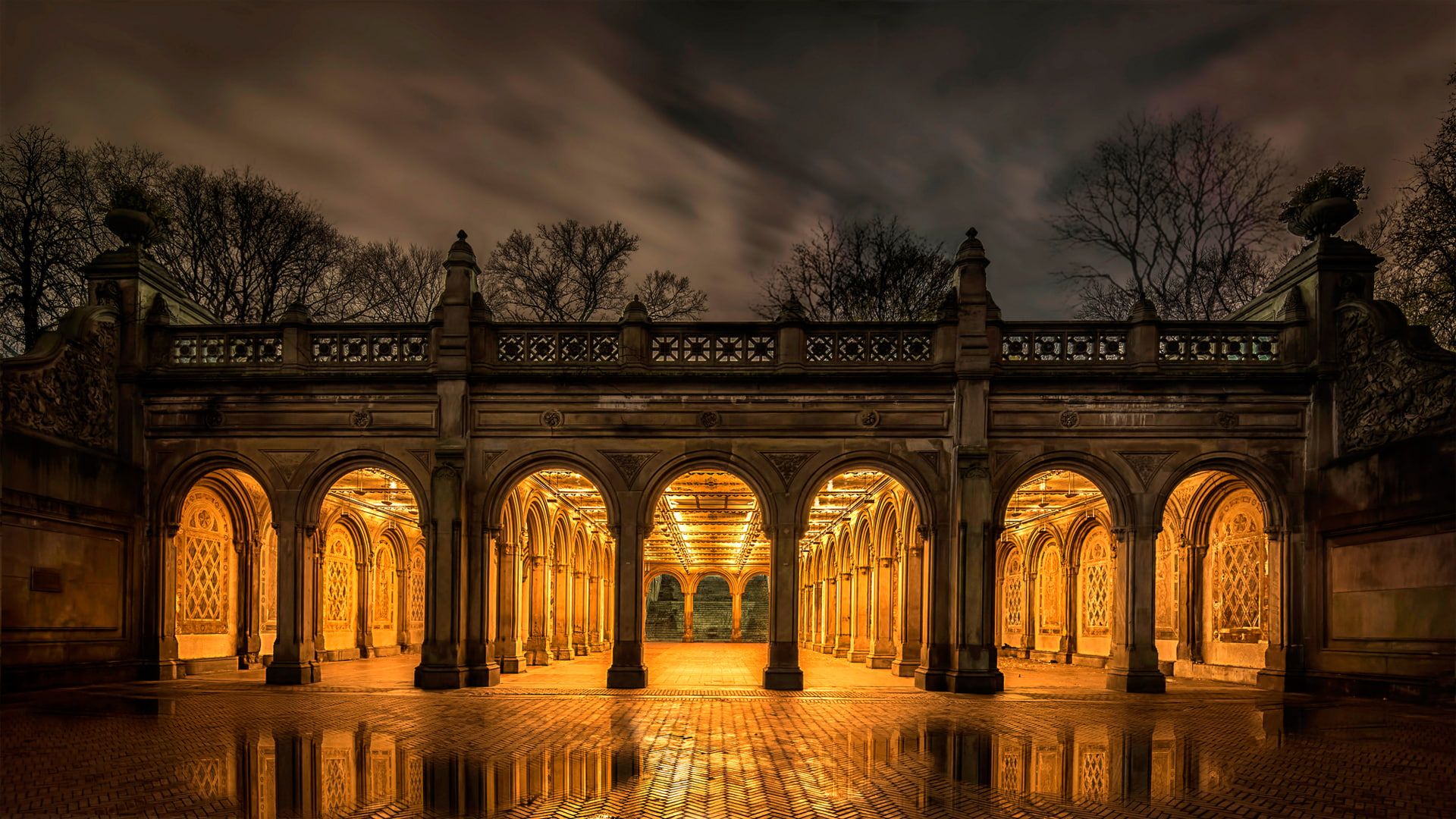
Arcade of Bethesda Terrace at night

Restored between 1983-2007, it is a marvelous place to spend a quiet afternoon. I feel very lucky to live so close by.

Saturday, February 5, 2011

Etruscan Shell Ice Cream Bowl

In the current issue of Majolica Matters, the newsletter of the Majolica International Society, Wanda Matthes writes about her visit to a majolica collector's home. Part of the article mentions viewing the collector's large Shell collection. As part of that collection Wanda makes a reference to our book, Etruscan Majolica, Volume 2.
The reference concerns the Etruscan M-6 Shell bowl.
GSH Shell nappy

Known informally as the Etruscan Shell Ice Cream bowl, the M-6 bowl is one of the most scarce pieces in the entire Shell catalog. An unconventional treatment of the Shell motif, very little is known about the history of the piece. It received the nickname of the ice cream bowl from the late collector Anna Stern who always referred to it in that way. It's entirely possible that she got that name from the former decorators of the Etruscan Works, many who she knew personally, but there is nothing in the surviving literature that backs that up. It is actually rather deep for a Victorian ice cream server. In the 1884 Catalogue of Majolica it is simply referred to as an 8" Shell nappy.


Its presence in the catalog gives us some information as to when it was created but having never seen the bowl in Ivory Ware or Venicine, tends to indicate that it is neither an early design nor a late one. Why it is so scarce is also a mystery. Most information points to the design being one that was discontinued soon after the publication of the catalog. The page on which it is shown was one of those removed from the Catalogue when it was redistributed after the 1884 Fair. Perhaps this is a reason why.

The bowl is generally found in one of two glaze combinations, the traditional one shown above and the green-lined example shown below, which featured mottled shells.

GSH Shell nappy

Because of its scarcity there is no real established price point for the bowl as there is the other Shell bowls. I have seen examples priced as high as $700 and as low as $80. In any event it is a bowl that you as a savvy collector should not pass on should you come across one. You may never see another one again.

Saturday, January 29, 2011

Majolica Spolight: Forester’s Rose and Rope Pattern

Forester majolica Rose & Rope teapot

One of the most commonly available patterns to the majolica collector is one attributed to English manufacturer Thomas Forester—Rose and Rope. It certainly must have been a successful pattern considering the large number pieces that have survived today.

Forester majolica Rose & Rope platter

Forester majolica Rose & Rope cake plate

Forester majolica Rose & Rope bread dish

Forester majolica Rose & Rope tea set

Forester majolica Rose & Rope plate and bowl

Forester majolica Rose & Rope plate

The pattern has a budding wild rose against a basketweave ground in a variety of colors. A rope wrapped around the pattern pieces divides the ground into quarters. All of the flat pieces have a cobalt center, but the basketweave surrounding it can be yellow, cobalt, gray, turquoise or brown.

Forester majolica Rose & Rope compote

Forester majolica Rose & Rope dessert service

Forester majolica Rose & Rope teacup and saucer

Forester majolica Rose & Rope matchbox

Forester majolica Rose & Rope humidor

Forester majolica Rose & Rope mustache cup and saucer

Forester majolica Rose & Rope tray

The pattern is quite reasonably priced in general with plates selling under $100 and serving pieces like teapots and compotes selling for around $300. Pieces with a cobalt basketweave ground sell for about 50% more than that of the other colors because are much less common.


*This post has been updated since it was first published.

Monday, January 24, 2011

The Case of the Curious Strawberry Pitcher

When you're buying on the secondary market, it's always a good idea to maintain a certain degree of skepticism about the authenticity of the object you're buying.

In the early 1990s I was a relative fledgling antiques dealer specializing in majolica. I had been buying for a few years by this time, but not a real seasoned professional by any means. As is typical for antiques dealers I traveled around the USA quite a bit, driving from antique show to antique show, setting up my wares and buying as I came across things.

On one of my trips to the Metrolina Antiques Show in Charlotte, North Carolina I saw a large, very heavy majolica pitcher that I had never seen before. It was cobalt blue with large, three dimensional strawberries on it and a stippled background. I picked up the piece and examined it. There was something about it that wasn't quite right but I couldn't really put my finger on it.  It had some wear and some dirt on it and was heavily crazed throughout. The underside showed dirt on the unglazed foot, a good sign that a piece had been around for a while. As I recall, the price was around $345. Since that seemed to be more of a retail price than wholesale price I passed on the pitcher and continued my rounds through the fair grounds.

Fantasy new majolica strawberry pitcher

After about an hour of walking around the fair I came across a second example of the same pitcher but in a bright opaque yellow glaze. Again, I picked up the pitcher and examined it. Like the first one it was very heavy for its size and showed crazing and dirt throughout. The price of this one I believe was around $385. I put the pitcher down and after a bit left the fair grounds for my next stop, Atlanta, Georgia.
I spent the week antiquing my way through Atlanta before hitting the Scott Antiques Show the following weekend. To make a long story short, in that time I saw three more of these pitchers in turquoise, brown and green.

I knew something was up. Here was a pitcher pattern that I had never seen before and it was suddenly everywhere. When I returned to Pennsylvania I started to see the same pitcher at various antiques shows, handled by some very well known majolica dealers. Soon the pitcher was showing up everywhere, from flea markets to the antique show of the Majolica International Society, Majolica Madness.

By this time I was convinced that it had to be a reproduction, but one done by someone who was very careful to add signs of age to it with the dirt and crazing. Still, the piece was selling like hotcakes throughout the majolica circuit, usually selling for about $350-500 a piece. The word on the street was that this was new "old" stock that had been discovered shuttered in a warehouse for many, many years.

I just didn't buy it.

Soon afterwards two different pitchers and an oyster plate surfaced that had identical characteristics to the strawberry pitcher. One pitcher was a very large pitcher with a stork on it that had been pictured in one of the Marks Majolica books and the other, a huge pitcher with a stippled body and bunch of fruit at the neck. The oyster plate is an identical copy of the Palissy fish head plate normally found in green with a pale yellow body but in a bright blue color palette white a white body. 
Reproduction majolica crane pitcher
Fantasy new majolica fruit pitcher
Reproduction palissy oyster plate
The original fish head palissy oyster plate

The pitcher with the fruit was easy to dismiss because it was another pattern no one else had ever seen--though that didn't stop it from selling very well at antique shows and fairs. The other two were more troubling. These were copies of real majolica patterns--very, very good copies.

When word got around that these copies were in circulation it completely destroyed the market for the genuine articles. Soon, knowledgeable dealers refused to carry the pitcher and oyster plate because they couldn't tell the difference between the real thing and the reproduction. For many years the patterns became pariahs with many dealers refusing to handle them.

Eventually all four of the pieces started to disappear and within a generation had succeeded in being absorbed into collections with many of the purchasers none the wiser. Today these pieces show up in dealers booths and auctions and generally command very good prices from those who don't know the history of the patterns

This is where the story should end, but it doesn't!

On one of my trips down South a few years ago, I came upon a dealer's booth filled with the fish oyster plates. The dealer handled real majolica but these plates were being sold as new for $35 a piece. They were marked with a paper label on the reverse. When I asked the dealer about them I was told that they were buying them directly from the manufacturer, a tiny pottery in South Carolina, run by a gentleman with whom they had an exclusive contract. Soon the pieces of the puzzle started to come together for me.

These reproductions that were being potted in the South were being purchased as new, the label was removed and they were working their way up the East coast as antiques. They were being sold as antiques by people who were either unintentionally or intentionally misled. Considering the care with which these pieces were "aged" I suspect it was the latter. I never did find out who that potter in South Carolina was but it gives me a cold chill to know that these reproductions, to this day, have fooled hundreds if not thousands of people into adding them to their collections. This is why I always tell new collectors to buy from dependable sources who know what they're selling.

An interesting post script to all this.
Recently other potteries that make reproductions of majolica have started copying the reproductions, probably without knowing the pieces they were copying were reproductions in the first place.


Both the large strawberry pitcher and the blue, palissy oyster plate have hundreds of copies of them floating around out there.

In an odd way you could say, what goes around comes around.

Monday, January 17, 2011

Majolica Spotlight: Wardle Bamboo and Fern

Wardle Bamboo & Fern majolica plate

One of the many majolica patterns that came out of the Aesthetic Movement, James Wardle and Company's Bamboo and Fern is also one of the simplest in design–a simple ground of bamboo with two bamboo ferns laying across it. When I first started collecting majolica it was one of the first English designs that caught my eye for its simplicity and boldness. A picker I knew had a huge set of it in his home. What an imposing display it made! The umbrella stand alone is just stunning!

Designed around 1880 at the height of the influence of Japanese art and design on Western decorative arts, it was available in four background colors: brown, dark gray-green, yellow and very rarely turquoise.
Wardle Bamboo & Fern majolica platter

Wardle Bamboo & Fern majolica platter

Wardle Bamboo & Fern majolica cup and saucer

It's quite an extensively realized pattern with pieces in all sizes and shapes. Like most Wardle patterns, the pieces are rarely marked but many of them do exhibit an English registry mark on the base.

English registration mark for Wardle Bamboo & Fern

Wardle Bamboo & Fern majolica mustache cup and saucer
Wardle Bamboo & Fern tableware 

Wardle Bamboo & Fern majolica cachpot
Wardle Bamboo & Fern majolica cachpot
Wardle Bamboo & Fern majolica matchbox
Wardle Bamboo & Fern majolica wall pocket
Wardle Bamboo & Fern majolica pitcher
Wardle Bamboo & Fern majolica cuspidor

Of the four available color grounds, the yellow is generally the most popular with pieces bringing prices about 25% higher than those of the brown or gray pieces. The turquoise ground is rare and will bring what the market will bear.

The only available reproductions that I have seen are of the brown teapot, creamer and sugar. The teapot is shown directly below. While they may fool from a distance, on closer look they are crudely glazed with unglazed interiors. I would find it difficult to believe that they could fool any knowledgeable dealer or collector.

Reproduction Wardle Bamboo & Fern majolica teapot

Wardle majolica was made to last. The pieces are heavy cast but the quality of the glazing is variable. Condition and craftsmanship are everything in deciding price with rarer pieces like the jardinières and umbrella stand bringing the highest prices.

Still, it is a nice pattern with roots dating back to an important period in the development of Western decorative arts. At a price point that everyone can afford, and enough availability and variety for any collector they make a good choice for the buyer looking for a pattern they can build on as the years pass.

*This post has been updated since it was first posted