A look at the design, market and legacy of Victorian pottery

Showing posts with label James Wardle and Company. Show all posts

Friday, July 22, 2011

The Case for Cuspidors


Cuspidors have an image problem.

When I was an antiques dealer traveling around the country I was surprised at the large number of majolica collectors who simply wanted nothing to do with cuspidors. Maybe it's the unfortunately vivid alternate name of "spittoon" that puts people off. It certainly can't be the pedigree. Cuspidors were made by virtually every majolica manufacturer from Minton to the tiniest independent pottery. It certainly can't be the design. Cuspidors come in every color and shape imaginable, from the elegant George Jones tortoise to the humble but beautiful Sunflower of Griffen, Smith and Company. No, it simply has to be the original intended usage, as a container for spittle or chewing tobacco. I can think of no other ceramic, save for the chamber pot, that has this problem.

According to Wikipedia, the golden age of cuspidors was from 1840 to 1918 though they've been in use in Asia for centuries. It took the flu epidemic of 1918 to put an end to its use by genteel society. Since this was also roughly the golden age of majolica manufacture it just makes sense that they would have been made in majolica as well as other materials.

While majolica collectors spurn cuspidors, they are adored by decorators. I can't tell you how many decorator rooms I have been through that feature at least one cuspidor as a flower vase. The large, squat shape of these containers are perfect for table centerpieces, allowing for plenty of flowers while not blocking the view of the guests on the opposite side of the table. Indeed, it is a wonderful vessel for this use though I would place a glass liner inside to protect it.

All that being said, there are some wonderful cuspidors  out there.

Forester Rose & Trellis cuspidor
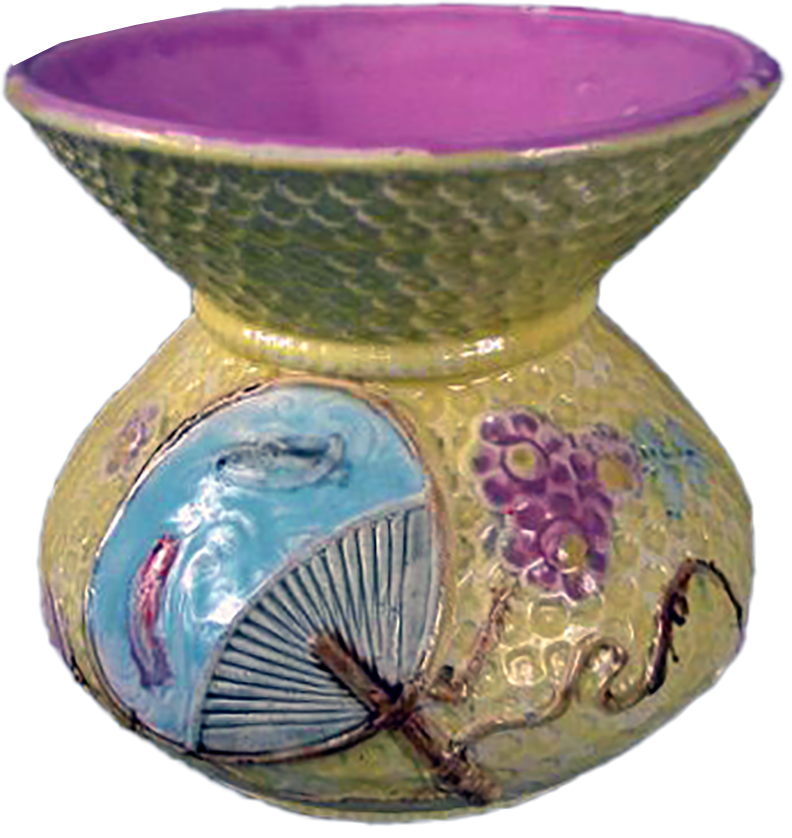
Wardle Fan majolica cuspidor
Holdcroft majolica water lily cuspidor
Majolica water lily cuspidor
Majolica frog cuspidor
Majolica fish cuspidor

Shorter & Boulton Shell cuspidor 


Samuel Lear majolica Sunflower cuspidor
Wardle/Lear majolica water lily cuspidor
McCoy Carnelian majolica cuspidor c.1904
Wild rose majolica cuspidor
Wardle maajolica Sunflower cuspidor 
Etruscan Majolica Shell cuspidor
Majolica pineapple cuspidor


Etruscan Majolica Lily cuspidor
Etruscan Majolica Sunflower cuspidor
Wardle & Co. majolica cuspidor 
Arsenal Pottery majolica cuspidor 
Adams & Bromley majolica cuspidor
Belfield Pottery majolica cuspidor 


Forester majolica cuspidor
Wardle Fern & Bamboo cuspidor

Forester majolica cuspidor 


George Jones tortoise cuspidor
. Lift off the shell and the hole for the spittle in underneath.

Etruscan Majolica Pineapple cuspidor 


Wouldn't one of these look great on your dinner table filled with fresh flowers?

*This post has been updated since it was first published.

Monday, January 17, 2011

Majolica Spotlight: Wardle Bamboo and Fern

Wardle Bamboo & Fern majolica plate

One of the many majolica patterns that came out of the Aesthetic Movement, James Wardle and Company's Bamboo and Fern is also one of the simplest in design–a simple ground of bamboo with two bamboo ferns laying across it. When I first started collecting majolica it was one of the first English designs that caught my eye for its simplicity and boldness. A picker I knew had a huge set of it in his home. What an imposing display it made! The umbrella stand alone is just stunning!

Designed around 1880 at the height of the influence of Japanese art and design on Western decorative arts, it was available in four background colors: brown, dark gray-green, yellow and very rarely turquoise.
Wardle Bamboo & Fern majolica platter

Wardle Bamboo & Fern majolica platter

Wardle Bamboo & Fern majolica cup and saucer

It's quite an extensively realized pattern with pieces in all sizes and shapes. Like most Wardle patterns, the pieces are rarely marked but many of them do exhibit an English registry mark on the base.

English registration mark for Wardle Bamboo & Fern

Wardle Bamboo & Fern majolica mustache cup and saucer
Wardle Bamboo & Fern tableware 

Wardle Bamboo & Fern majolica cachpot
Wardle Bamboo & Fern majolica cachpot
Wardle Bamboo & Fern majolica matchbox
Wardle Bamboo & Fern majolica wall pocket
Wardle Bamboo & Fern majolica pitcher
Wardle Bamboo & Fern majolica cuspidor

Of the four available color grounds, the yellow is generally the most popular with pieces bringing prices about 25% higher than those of the brown or gray pieces. The turquoise ground is rare and will bring what the market will bear.

The only available reproductions that I have seen are of the brown teapot, creamer and sugar. The teapot is shown directly below. While they may fool from a distance, on closer look they are crudely glazed with unglazed interiors. I would find it difficult to believe that they could fool any knowledgeable dealer or collector.

Reproduction Wardle Bamboo & Fern majolica teapot

Wardle majolica was made to last. The pieces are heavy cast but the quality of the glazing is variable. Condition and craftsmanship are everything in deciding price with rarer pieces like the jardinières and umbrella stand bringing the highest prices.

Still, it is a nice pattern with roots dating back to an important period in the development of Western decorative arts. At a price point that everyone can afford, and enough availability and variety for any collector they make a good choice for the buyer looking for a pattern they can build on as the years pass.

*This post has been updated since it was first posted