A look at the design, market and legacy of Victorian pottery

Showing posts with label Massier. Show all posts

Thursday, May 15, 2025

Ceramics that are Confused for Majolica but Aren’t Majolica

There is quite a bit of ignorance about the definition of Victorian majolica. This is actually quite natural. No one can know everything and a specialized collecting area like Victorian majolica is bound to confuse people. This post is an attempt to clarify some of these misconceptions to those who may be new to this particular collecting area. 

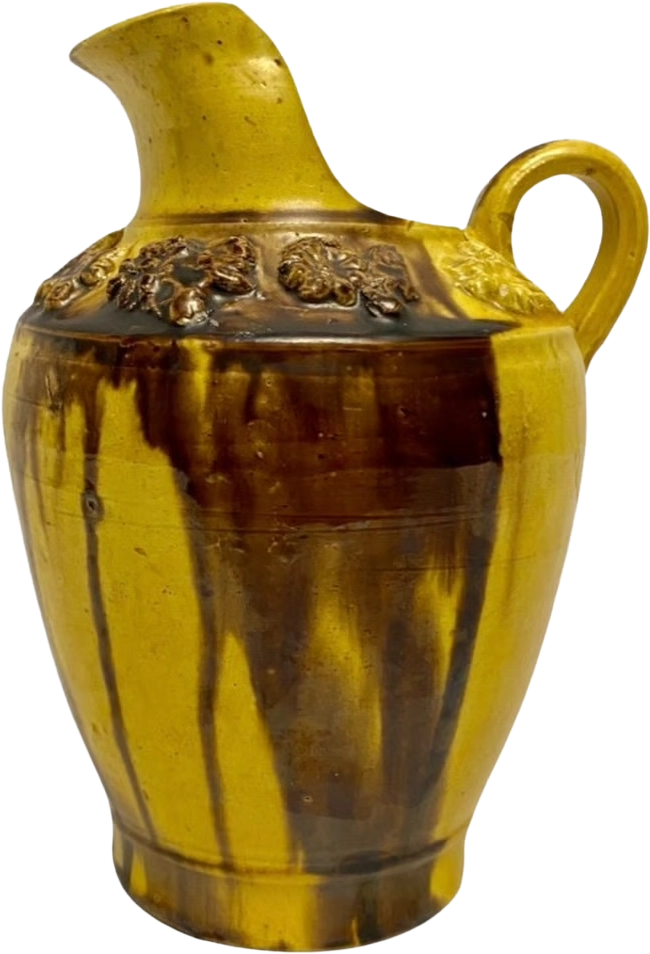
Mexican dripwire duck pitcher

For the purpose of this blog the term majolica is used to describe the lead-glazed pottery invented in England by Minton in 1851 and continued throughout Western Europe and the United States until roughly around 1920. It continued in Central Europe until the onset of WW2. Three examples of Victorian majolica can be seen directly below.

Forester majolica cockatoo basket

Adams & Bromley majolica cornbread tray

Massier majolica iris jardiniere

To make it simpler, let me just say upfront that any pottery marked “Italy,” "Japan,” “China” or “Mexico” is not Victorian majolica as none of these countries ever produced lead-glazed majolica pottery. Let me elaborate.

The pottery most commonly confused for majolica is maiolica. I have discussed the differences between maiolica and majolica before, as well as described how this confusion began. It’s really the fault of the inventor of Victorian majolica, Léon Arnoux and his employer Minton. The two forms were confused from the beginning and the confusion has persisted ever since. Although the two illustrations below are from 16th century Italy, this highly detailed, hand decorated tin-glazed pottery is still in production today throughout the world. The most obvious difference is that majolica has lead-based glazes whereas maiolica has tin-based glazes. Delft nor faïence are considered majolica either because they too have tin based glazes. For clarification on Deft please refer to my post on faïence below.

Castelli maiolica vase c.1530

Gubbio maiolica marriage dish c.1535

A type of pottery often confused for majolica and commonly found in the U.S. is Mexican Dripware. This is a specific product made in Oaxaca, Mexico for the tourist trade. It has a folksy, primitive look and can be attractive in a large grouping but it is not majolica.

Mexican dripware coffee pot

Mexican dripware swan pitcher

Mexican dripware jardiniere

Mexican dripware pitcher

The Japanese created an inexpensive pottery for export similar in look to majolica during the 20th century. These pieces are marked "Japan," "Occupied Japan" or "Made in Japan."

Hotta Yu Shoten Japanese basketweave lidded pitcher

Japanese biscuit jar

Japanese Banko shell teapot

Japanese export vase

Another pottery that is confused for majolica is faïence as mentioned at the top. Most commonly referred to as “quimper” in the United States it originated near Quimper Brittany, France by potter Jean-Baptiste Bousquet in the late 17th century but continues production to this day. The term, however, has become a generic one describing any tin-glazed pottery with a similar type of decoration. To add a bit of confusion though, the term faïence is sometimes erroneously used to describe any form of colorful pottery made in France. More confusing yet, the decoration technique is sometimes used by the same manufacturers who made majolica. Quimper has a naïve hand panted Breton folk art decoration that speaks for itself. Delft ware is a type of faïence with a different decoration inspiration originating in Northern Europe.

Quimper faïence platter

St. Clément faïence plate

Angoulême faïence wall vase

In the United States the Chesapeake Pottery of Baltimore used the term faïence to describe some of their lead-glazed majolica. This was probably done for marketing purposes. Imported ware was considered more desirable by American consumers, hence a piece with a European sounding name may sell better. 

Nothing is ever cut and dry in the antique pottery world!

Mark for the Chesapeake Pottery's Haynes Avalon Faience majolica line

Chesapeake Pottery advertising 

It should go without saying that the ceramic reproductions made today that imitate majolica such as these frog pieces from Southern Asia are not majolica but should be considered majolica-style pottery. Victorian majolica was never made in Asia. A search through this blog on reproductions can be helpful to the novice in identifying these.

Navigating pottery attribution can be a hazardous one even for professionals as I have written on this blog but with a little experience anyone can master it... or at least come close!

Sunday, June 4, 2023

Majolica in the Media: Celebrity Antiques Road Trip

If you're like me you're always on the lookout for interesting ceramics in the background of movies and television shows. Usually these things show up in period dramas but once in a while they show up in contemporary settings as well.


One such type of TV show I scour frequently for these things are those devoted to antiques. Such a program is Celebrity Antiques Road Trip on PBS. This is a different version of a game I used to watch all the time on BBC TV, Antiques Road Trip. until it was dropped from my local carrier. I understand Antiques Road Trip it is still in production in the UK, heading into its 25th season. Some reruns of both shows can be seen on Peacock and Pluto in the US and a number can be found on YouTube.

In Antiques Road Trip several antiques dealers scour the English countryside for items that could make them a profit when sold at auction. Each dealer has a certain amount of money to spend, and they travel around and purchase what they think are the best deals they find. Celebrity Antiques Road Trip adds the twist of including celebrities among those searching for profits. This program has also had a long run in the UK, currently in its tenth season.

Both of these programs are very typically British— proper with lots of English references that would go over the head of most outside the UK, mixed with a few dull British history lessons. I've only seen one season of Celebrity Antiques Road Trip but of those celebrities featured during the season there was only one celebrity that I recognized, the late Diana Rigg. Mostly they are British celebrities unknown to a general international audience outside of the UK.

The episode that caught my attention is from the Fourth season, Episode 11. In this episode the "celebrities" John Craven and Johnny Ball teamed up with two knowledgable dealers Alistair Stewart and Charles Hanson. I wish I could report that they purchased lots of ceramics for their auction selections, but alas, they bought only a couple, a pair of Bretby jugs dating from the 1930’s. There were quite a few pieces of Victorian majolica in one of the stores they shopped in though in Ringwood. Oddly enough they were mostly French majolica, not British.

A set of Salins asparagus plates 
grace the table at the entrance to the shop, with a group of  
Luneville artichoke plates on a plate rack.

Salins majolica asparagus plate

Some Onnaing dessert plates, a French asparagus cradle and a 
blackamoor smoking stand are displayed on one of the store shelves. 
The pineapple pitcher is presumably English
Onnaing majolica dessert plate Corinthe 

English majolica pineapple jug

Continental majolica blackamoor match striker

A Massier majolica jardiniere and
a Longchamp majolica master oyster plate are displayed in one scene

Longchamp majolica master oyster plate

A second view of the shelf holding the majolica exposes an 
Onnaing duck pitcher on the top shelf.

Onnaing majolica pitcher Canard

As antiques dealers these celebrities were a dismal failure with one team losing money on their final purchases and the second only making a small profit, sort of like in the real antiques business! 

In other episodes I spotted a Shorter & Boulton Fan sugar bowl and an Adams & Bromley corn bread tray, which antiques expert David Harper described as “ just gorgeous” which celebrity Esther Ranzten described as “one of the most hideous pieces of china” she had ever seen. I guess there’s no accounting for people’s taste.


Adams & Bromley corn bread tray

It's an enjoyable program worth your time if you find this sort of thing interesting, which I do.

Wednesday, October 26, 2022

Majolica in the Movies: Secret Ceremony

Since the month is October with Halloween around the corner, television and cable stations are pulling out every strange and spooky movie in their library. Naturally, a film that fits both of those qualities is bound to appear on the airwaves—the 1968 film Secret Ceremony. With an unlikely cast that includes Elizabeth Taylor, Mia Farrow and Robert Mitchum, the story concerns a woman of means, in this case a prostitute, and an odd girl who bears a strong resemblance to her deceased daughter, Mia Farrow. Fitting into this peculiar relationship is the young girl’s estranged step-father, played by Robert Mitchum.

The plot of this bizarre British film is more peculiar than we really need to discuss here. What caught my eye however, was a large jardiniere on a table in the living room of the prostitute’s mansion containing a cactus plant much too small for its container—a floral Massier jardiniere.

Image from the film Secret Ceremony

Similar, if not identical, to the jardiniere shown below, the form is unmistakably Delphin Massier.

Massier majolica floral jardiniere 

Unfortunately—or not—this was the only piece of majolica in the film, but it makes its appearance early in the story so one doesn’t need to subject oneself to the entirety of this odd movie to catch it. Of course, if movies of this nature appeal to you, feel free to indulge. As for myself, I turned the channel to something a little less strange, the 1932 movie Freaks!

To view the movie trailer go here.

Sunday, July 10, 2022

Another look at Dogs in Majolica

We did a post on dog themed majolica quite some time ago. Not too long ago we took a second look at cat themed majolica. I thought it may be the right time to give man's best friend a second look as well.

Here are some dog pieces we didn't include last time. Let's start with the English potteries.

Minton majolica wine cooler/ice stand
Minton majolica boy with dog
Minton majolica master salt

Minton majolica master salt
Minton majolica hound

Minton majolica dog and fox tile

Minton majolica hunting tile

George Jones majolica stein
George Jones majolica mug
George Jones majolica hunting charger
George Jones majolica terrier bowl
George Jones majolica terrier pin tray
George Jones majolica hunting terrine with hunter and dog finial
George Jones majolica hunting terrine with stag finial
George Jones majolica boar terrine

George Jones majolica pin or ash tray
George Jones majolica desk stand
George Jones majolica smoking set
George Jones majolica hunting dog compote
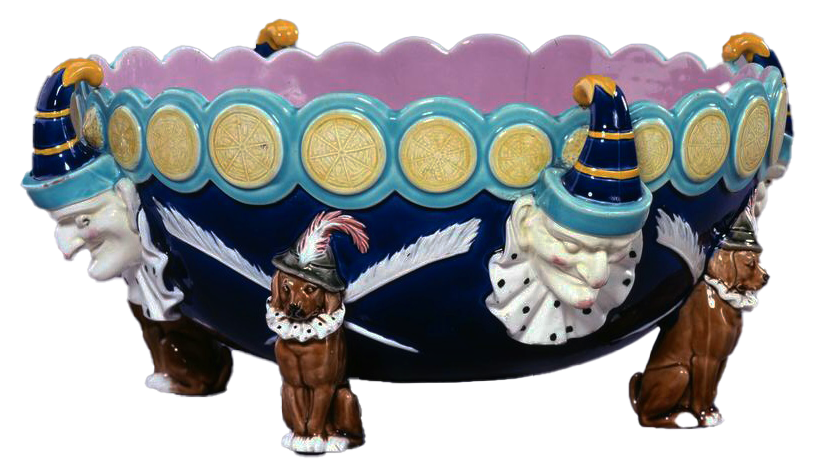
Wedgwood majolica Punch bowl with Toby feet
Wedgwood majolica dog and hare hunting terrine
Wedgwood majolica dog transfer plate


Wedgwood majolica hunting dog tiles
Holdcroft majolica dog in barrel humidor

Holdcroft majolica girl and dog
Holdcroft majolica match or toothpick holder
Brown-Westhead Moore majolica dog vase

Brown-Westhead Moore dog match holder
Brown-Westhead Moore dogs and shoe
Brown-Westhead More moon vase with enamel dog portrait
Brownfield majolica terrier 
Brownfield majolica dog match holder

Enoch Wedgwood majolica syrup pitcher
Royal Worcester majolica pitcher with dog cover
Unattributed English majolica dog and shoe sweetmeat

Unattributed figure from an Alcock original
Unattributed English majolica dog and shoe sweetmeat
Unattributed English majolica man with dog figure

Unattributed boy with dog
Unattributed dog umbrella stand
Unattributed majolica dog match striker
WS&S majolica smoker
Unattributed hound tile

The French as well as other Continental potteries did quite a bit of majolica with le chien themes as well.

Théodore Deck majolica vase/planter
Theodore Deck majolica wall pocket
Massier majolica dog figure
J. Massier dog box
Massier majolica dog vase
Majolica dog marked Clement Massier Golfe Juan 
Masssier majolica terrier figure
Massier majolica wall pocket
Massier majolica dog wall pocket
Choisy-le-Roi majolica hound

Onnaing majolica dog plate

Onnaing majolica strawberry server
Onnaing majolica bulldog pitcher
Fives-Lille majolica Pichet Chien bien timide
Orchies majolica life size dog vase
Wasmuël majolica jardiniere
Wasmuël majolica dog pitcher
Desvres majolica dog pitcher
Wasmuël majolica dog pitcher
Wasmël majolica jardiniere
Wasmuël majolica hunting plate
Wasmuël majolica dog and cat jar
French majolica dog cart
Wasmuël majolica umbrella stand
Wasmuël poodle vase
Bernard Bloch majolica dog
Block majolica box
Sarreguemines majolica hunting plaque
Sarreguemines majolica puppy pitcher
Sarreguemines majolica Chinese foo dog
Vierzon majolica dog pitcher signed Perrot
French majolica spaniel pitcher
Nimy majolica dog handled pitcher

St. Clement majolica dog in basket pitcher
St. Clement majolica bottle for Garnier
St. Clement majolica poodle pitcher
Desvres majolica dog police pitcher
French majolica police dog
French majolica spaniel pitcher
Cork & Edge majolica jug Keeper's Daughter from an Alcock original

Unattributed French majolica jardiniere, possibly Onnaing

Unattributed French majolica window box
Unattributed French majolica dog house
Continental majolica boy and dog planter

Unattributed majolica dog vase
Continental majolica bulldog humidor
Continental majolica humidor
Austrian majolica dachshund humidor
Alvas Palissy majolica coffee pot
Morley majolica dog figure

French banks for small children were popular giveaways to encourage them to save their francs.

Wasmuēl majolica dog bank

Wasmuēl majolica dog bank


Orchies majolica dog bank

Onnaing majolica dog bank

St. Uze majolica dog bank
Unattributed dog bank
Unattributed majolica dog bank

I thought I'd finish this post with some dog adjacent pieces from George Jones—a trio of majolica dog bowls!

George Jones neoclassical majolica dog bowl
George Jones majolica dog bowl