A look at the design, market and legacy of Victorian pottery

Showing posts with label Majolica Spotlight. Show all posts

Sunday, September 4, 2011

Majolica Spotlight: Banks & Thorley Bamboo

Banks and Thorley as a pottery didn't last very long–they were only in operation from 1875 to 1886, but they left their mark on majolica with their beautiful Bamboo pattern.

Potted at the height of the Aesthetic Movement, the pattern was a response to the influence of Japanese tastes on Western decorative arts. It is a large, fully realized pattern that must have been very popular in its day judging from the number of pieces that survive today.

The pattern is really a very simple one. The ground of all the pieces is a golden basketweave against which are displayed multicolor bamboo fronds. The handles are usually brown.


The pattern is available with several different size pitchers of two different types. The first, which is the most common, is pictured above. It has a smooth rim and a spout. The second has an unusual ragged top rim. This type was made without a spout.


 The pattern came with both a teapot and tea kettle. One small teapot, most likely part of a breakfast set, was available with butterfly wing handles.


There are also two different cream pitchers, two different sugar bowls and two types of teacup. The one type has the brown reed handles of the other pieces while the other has delicate butterfly handles to match the butterfly handle teapot.


 In addition the pattern came with the usual other pieces: butter dish, butter pat, dessert plates, dessert stand and basket.


Most of the pieces wear an applied English Registration Mark on the base indicating the pattern was registered by Banks & Thorley on May 17, 1876.


Banks & Thorley ad 1886

Bamboo is a good pattern for the beginning majolica collector . Pieces are relatively inexpensive, available and very decorative. A complete teaset is a thing of great beauty.

Sunday, December 26, 2010

Majolica Spotlight: Vine and Strawberry Plates

One of the most commonly available majolica plate designs is the Vine and Strawberry plate. I don't know who did the original design. I remember reading once that it was a Copeland design but I've never really seen any confirmation of that. I know that Alcock made the pattern in majolica in the early 1850s which preceded Wedgwood's entrance into the majolica market but it's possible Wedgwood made the pattern in other bodies before that.

I'm really not sure why it's called Vine and Strawberry either which is the name in the Wedgwood pattern books. "Grape and Strawberry" or "Leaf and Strawberry" would make more sense to me but then they never asked my opinion.

Certainly the most famous examples are from the afore mentioned Wedgwood. They made it in a number of different shapes and servers and a wide variety of color combinations including the Argenta color palette popular during the 1870's. The Argenta color plate was available in two sizes.


It's a pattern they've been making almost continuously from the 1800s until recently, in every pottery type from solid green to majolica to yellowware to drabware to bone china. In the post-war 1940's they reintroduced a majolica line without lead glaze in a distinctive yellow ground that has proven to be just as popular as the Victorian original with collectors.


I have a set of these in white bone china that I bought new thirty years ago and have used regularly ever since. Wedgwood even created a matching line of bone dinnerware called Strawberry and Vine that has proven popular on it's own.

Wedgwood bone china Strawberry & Vine

But Wedgwood was not alone in making this pattern. It was one of the most commonly copied patterns made in majolica. Gustavsberg, Davenport, Edge Malkin Co., and Brownfield made beautiful examples that match the finest of Wedgwood's examples.

Gustavsberg majolica grape plate


Brownfield majolica grape plate

There were also other potteries both in the US.and Britain that made their own examples of the plate. One of the earliest and rarest was Samuel Alcock who introduced their full color majolica example in the 1850s. The Arsenal pottery in the U.S. also made a simpler version in the late 1800s-early 1900s.

Samuel Alcock majolica grape ptale

Arsenal majolica grape plate

Today it is found in green glaze most frequently having been made in large quantities in that color by Wedgwood, Edge Malkin & Co. and Davenport.


In all of its incarnations, it's a great design that has proven its durability and one that deserves a place in the pantheon of great majolica patterns.

Monday, August 30, 2010

Majolica Spotlight: Lear's Sunflower & Classical Urn and Narcissus

Lear majolica Sunflower platter

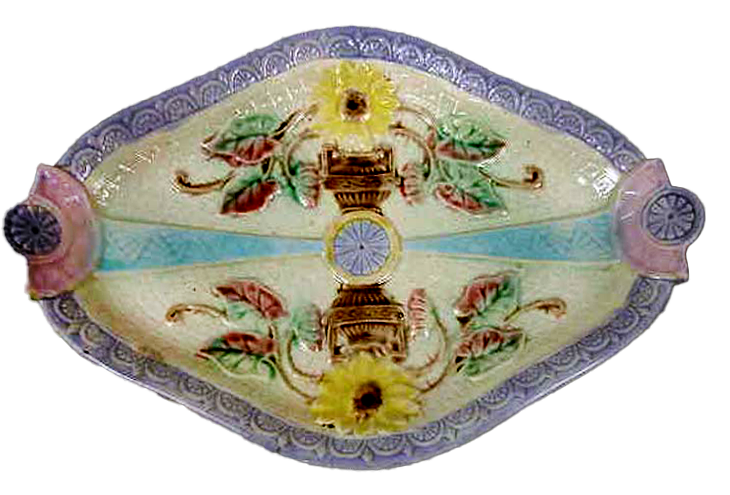
Few majolica patterns embody the precepts of the Aesthetic Movement more than Lear's Sunflower pattern, also sometimes referred to as Sunflower & Classical Urn. Registered in August of 1887 as Sunflower, the pattern is a mad explosion of rigidly organized abstraction typical of Japanese design mixed with images from the Aesthetic Movement. As the symbol of the movement itself, the sunflower was the primary focus of the pattern. The classical urn was a design device used quite a bit during this period, appearing in hundreds of different motifs including the two Wedgwood patterns below.

Wedgwood majolica Argenta Aesthetic Movement pitcher
Wedgwood majolica Grosvenor pitcher
Lear majolica Sunflower oyster plate
Lear majolica Sunflower creamer
Lear majolica Sunflower mustache cup
Lear majolica Sunflower cup & saucer

Lear majolica Sunflower pitcher
Lear majolica Sunflower platter
Lear majolica Sunflower sardine box
Lear majolica Sunflower punch bowl
Lear majolica Sunflower butter dish
Lear majolica Sunflower butter pat
Lear majolica Sunflower cuspidor
Lear majolica Sunflower tea pot

Sunflower was a successful and extensively utilized pattern for the company, made in everything from huge tea trays to cuspidors to cane stands. I have seen few marked examples.

It spawned an almost identical twin, Narcissus, where the sunflower and urn were replaced by intertwined red Narcissus flowers. 
Lear Narcissus tea set
Lear majolica Narcissus platter
Lear majolica Narcissus fruit stand
Lear majolica Narcissus oyster plate
Lear majolica Narcissus bowl
Lear majolica Narcissus plate
Lear majolica Narcissus butter pat

An advertisement featuring Lear’s work showcases their Sunflower pattern.


Both patterns are colorful, readily found and reasonably priced. They're a wonderful way of bringing a bit of the 19th Century Aesthetic Movement to your 21st Century home.

For more information on Samuel Lear majolica go here. For more information on the sunflower’s importance in late 19th century iconography go here.

*This post has been updated since it was first posted