A look at the design, market and legacy of Victorian pottery

Thursday, May 3, 2018

New Discoveries in American Majolica

The Bard Graduate Center recently hosted a lecture by Research Associate Dr. Laura Microulis on her research into American majolica. The lecture concentrated on the work of the Peekskill Pottery, Arsenal Pottery and Eureka pottery. While most of her work on the Peekskill Pottery and Arsenal Pottery was basically a repackaging of information which had been published before–both in this blog and in other reference material– her research on the Eureka Pottery was new and important.

Tenuous teapot from the Peekskill Pottery

Photo of the Mayer bros, founders of the 
Arsenal Pottery, from the Bard lecture

Dr. Microulis offered the theory that much of the work previously attributed to Eureka was in fact potted by other companies from the area. Speaking for myself, her attribution of the famous majolica Fan Ice Cream pieces to the nearby Willets Manufacturing Company’s Excelsior Pottery instead of the Eureka pottery resolves an issue I have had with the Eureka attribution for many years. This original mistaken attribution gained prominence through the Charles Rebert book  American Majolica 1850-1900 and the Mariann Katz-Marks Majolica Pottery books of the 1980’s. These reference books were the very first books on the identification of American majolica to reach wide circulation. As such they’ve had a disproportionate effect on the information that has circulated since.

M. Charles Rebert majolica reference

Photo of "so called Eureka" wares from Rebert's American Majolica 


The most recent edition of the Mariann Katz-Marks book

The Fan ice cream set bears none of the familiar characteristics of known, marked Eureka pieces. The glazes are different, the reverse is glazed differently and the design and craftsmanship is more sophisticated. I have actually wondered if this set was in fact English but all the known literature attributed the pieces to Eureka. It is actually an original design of Shorter & Boulton copied in America, but by who?

Dr. Microulis has uncovered the previously unknown existence of a major American majolica manufacturer who created these pieces. Willets was a large Trenton company best known for their American Belleek and art pottery. What was not known until recently was their contribution to American majolica.

Advertisement from Crockery & Glass 1882 listing the Fan Ice Cream Set
featured in the Bard lecture.


In addition to work of the Willets Company, Dr. Microulis identified pottery shards in South Carolina which copied Eureka's molds. There doesn't seem to be any proof as yet that the South Carolina Pottery Co. created copies from these Eureka molds but the indication of the possibility of these copies is clear.

Pottery shards from the S.C. Pottery Co. (right) that
copied the Eureka holiday plate

There was one small error in the attribution of the Eureka Hare butter dish design. It is not an original design as Dr. Microulis claimed but a copy of a Wilhelm Schiller & Son design. Other companies copied this design as well so the confusion is understandable.


Eureka butter dish underplate showing the classic 
Eureka mark and sponged reverse.

Schiller & Sons  caneware butter dish

Dr. Microulis's groundbreaking work is in conjunction with an exhibition of English and American majolica, Majolica Mania, to be staged in 2019. Her lecture adds significant new information to the literature on American majolica and is worth the time for anyone interested in the history of American majolica pottery.

The lecture in its entirety can be viewed online here.

Friday, February 16, 2018

Minton in the Movies

Some time ago I did a post of Majolica in the Movies over a piece of majolica I perceived to have been used in the movie Pillow Talk. What I somehow managed to miss in that post though was two pieces of Minton used earlier in the same film. Oddly enough they are the same pattern piece also used in the movie What Ever Happened to Baby Jane— the Minton Thorwaldsen jardiniere—although in Baby Jane only one is shown. Whether either of the pieces used in Pillow Talk are the same exact piece used in What Ever Happened to Baby Jane there is no way to know for sure but it appears that the center medallion in those used in Pillow Talk have birds in them whereas the one used in Baby Jane looks like a landscape similar to the one shown below, but there is a case for saying it's possible.

Scene from Pillow Talk showing the Minton Thorwald jardinieres

Scene from Baby Jane showing the Minton
jardiniere on the dresser in the background

“But ya are Blanch, ya are in that chair”

Pillow Talk and What Ever Happened to Baby Jane were made around the same time, Pillow Talk in 1959 and What Ever Happened to Baby Jane in 1962. One movie was filmed in color and the other in B&W so glaze colors can’t help in the identification, but both movies were independent productions filmed in Hollywood so they were each free to draw upon the same studio prop resources. In Pillow Talk the pair of jardinieres are part of the inventory of a decorating firm. In Baby Jane one sits on Blanche Hudson’s dresser.

Minton Thorwaldsen jardiniere

Another piece of Minton majolica shows up in the movie Rhapsody in Blue. It is the Minton mermaid centerpiece Flower Bearers. 

Minton majolica Flower Bearers

Scene from Rhapsody in Blue

Purchased by Warner Brothers from a California estate in the 1940s, the piece appears on George Gershwin’s mantel in the film. The same piece was later used in the movie Annie on a table in Daddy Warbucks’ home. The story of this Minton centerpiece is a tale unto itself.

Scene from Annie

Another piece of Minton appears in Annie as well, a Minton pedestal, shown briefly in a bathroom

Scene from Annie

Minton majolica pedestal

An identical pedestal in a brown ground appears in the movie The Normal Heart.

The Normal Heart

It’s not uncommon for movie props to show up in numerous productions. The majolica clock that appears in Gigi (1958) also appears in David Copperfield (1936), In the Good Old Summertime (1947), Time Machine (1960) and several westerns. The antique boat bed in Sunset Boulevard (1950) was also used in several movies: Trifling Woman (1922); The Phantom of the Opera (1925); Twentieth Century (1934); and Good Neighbor Sam (1964).

Scene from Gigi showing the frequently used majolica 
clock in the background.


Majolica clock in David Copperfield (1936)

Antique bed built for entertainer Gaby Deslys. 
It that has appeared in multiple movies


Scene from Twentieth Century showing the antique bed in the background

Scene from Sunset Boulevard that features the antique bed shown above

It's also common to see the same sets used in different movies. The extravagant Victorian staircase built for The Magnificent Ambersons (1942) was also used for the Cat People (1942), The Falcon in Danger (1943), and The Spiral Staircase (1946). Another stair, the prominent, ever changing staircase in the film Auntie Mame (1958), appeared in at least fourteen other films! There’s an entire blogging industry behind searching out props and locations appearing in multiple movies. One of my favorite blogs of this kind is Recycled Movie Costumes which furnished a couple of the images used in this article.

Should you see the Thorwaldsen jardiniere or the Flower Bearers in any other mid-century movie please let me know and I'll post it here.

Monday, January 15, 2018

Majolica Clocks

French majolica case made for New Haven Clock Co.

Ceramic clocks have a long history in European ceramics dating to Meissen's elaborate porcelain clocks of the early 18th Century. This tradition continued particularly in Germany and France through the last half of the 19th Century and the period of majolica manufacture. Elaborate clocks and matching garniture sets were extremely popular on the continent from the Belle Epoch to the early deco period. While there are examples of British and American clocks from the period, this was an area where continental majolica dominated. Wasuel, the Barbotine manufacturers, Dreyfuss, Sarreguemines, Massier and Choisy-le-Roi all contributed to the output. Some also made stands for gentlemen’s watches. I have included these as well.

Massier majolica iris clock
Massier majolica pansy clock
Massier majolica bird and floral clock
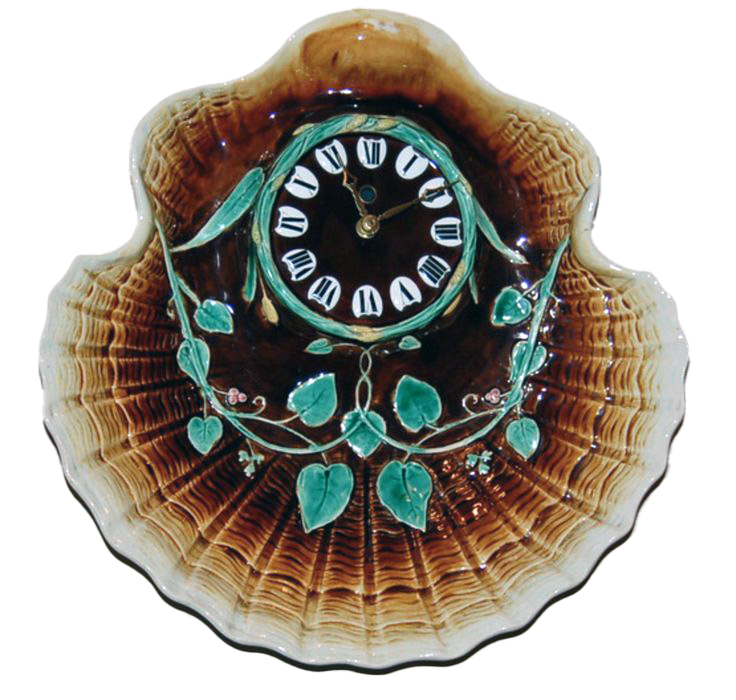
This Choisy-le-Roi shell clock repurposed the tray
from one of their food servers

Sarreguemines majolica clock

French Barbotine majolica clock
Barbotine floral majolica clock
E. Gilles Barbotine clock

Barbotine majolica garniture set
Wasmuẽl majolica clock
Wesmuël garniture set
Sergent majolica wall clock

Sergent majolica wall clock
Les Amis French majolica clock

Georges Dreyfus majolica clock case 
made for the New Haven Clock Works
Georges Dreyfus majolica clovk
Georges Dreyfus majolica watch stand
Choisy-le-Roi majolica clock

Choisy-le-Roi majolica rooster clock
designed by Robert Louis Carrier Belleuse

Gien majolica clock

Lonitz, Schiller and Eichwald and other potteries of Bohemia all had their own take on the clock form.

Lonitz majolica clock and thermometer
Lonitz stag clock
Austrian majolica wall clock and thermometer
Continental majolica clock in the Barbotine style
Lonitz majolica clock
Palissy type continental majolica clock
Strnact majolica clock
Austrian majolica Brownie clock
Karlsruhe majolica clock
Continental majolica mantle clock
Eichwald majolica clock
Schiller & Son majolica garniture set

The English and American potters also made clocks. Of the American manufacturers, Haynes made and manufactured a number of different models of mantle clocks and garniture sets. The New Haven Clock Works sold a number of majolica clocks using their own movements; the majolica cases however were imported from France.
Minton majolica clock
Wedgwood majolica clock
George Jones majolica watch stand

Haynes clock in the Barbotine style
Haynes majolica mantle clock 
Haynes majolica clock
New Haven Clock Works clock in French majolica case

Clock collecting is a specialty area that attracts more general clock collectors than majolica collectors. This has kept the price of most pieces reasonable.