A look at the design, market and legacy of Victorian pottery

Friday, April 22, 2022

The Majolica of Samuel Lear

Samuel Lear Sunflower oyster plate

Probably the single most famous piece created at the Lear Pottery is the sunflower oyster plate seen above, but as is true of the smaller potteries of Staffordshire, little is known about the company that created it. 

Beginnings 

Samuel Lear had a brief but memorable career in the manufacture of majolica. Born in 1853 in Norton-le -Moors Staffordshire near Hanley to Samuel and Hannah Lear, like so many potters before him, he was a child of the Staffordshire potteries. His father worked as an operator of the kilns at one of the nearby potteries. At the age of eight he joined his father's trade as a pottery ovenman. In 1871 the ambitious young man was registered in the census as a "potter's fireman." By the age of 21 he opened his own business in Hanley, believed to initially be a pottery warehousing business but is believed to have expanded to decorating china made by other potteries. About 1876 he opened his own pottery at the Mayer Works, manufacturing all forms of earthenware. 

Same Lear earthenware Jasperware cheese dome

In 1881 he also began the manufacture and advertisement of majolica, largely in the Aesthetic taste. The following year he expanded his pottery with additional facilities.

"Samuel Lear erected a small china works on part of the site of the old manufactory, which included as warerooms and offices the residence of Mayers. Mr. Lear produced domestic china and, in addition, decorated all kinds of earthenware made by other manufacturers - a specialty being spirit-kegs. He added to his Mayer Street works a new manufactory, built by himself in 1882, in the High Street and there carried on a successful manufacture of ordinary china, majolica, ivory body earthenware, and Wedgwood-type jasper ware."Jewitt's Ceramic Art of Great Britain 1800-1900

Mayer Works pottery

1882 Lear trade ad Keates Directory

Lear trade advertisement

Lear trade ad

Majolica Patterns

Although Lear created and registered his own majolica designs it’s ironic that the two majolica patterns that are most closely associated with his name today have origins at other potteries. 

The Wardle water lily pattern is probably the one most associated with the Lear pottery today. It is assumed that since Wardle was a competitor in the majolica market, it was either outright copied from Wardle or possibly a pattern licensed to the Lear company. In any event, it was a design potted by both companies (and probably even by Forester) but most closely associated with Lear today in spite of being a Wardle original.

Lear/Wardle majolica water lily pitcher
Lear/Wardle water lily tea tray
Lear/Wardle water lily tea set
Lear/Wardle majolica mustache cup & saucer
Lear/Wardle majolica cup & saucer
Lear/Wardle lily spooner
Lear/Wardle water lily bread plate
Lear/Wardle water lily vase

The rope and lily pattern was another one originally created at another pottery. This design was registered by James Edwards and Son. 

English Registration of Edward's rope and lily design

Edwards & Son salt glaze pitcher

When Edwards & Son foundered in 1881, Lear purchased the rights and the molds for the pattern and began producing it in large quantities in majolica expanding its design motifs to different shapes.

Samuel Lear majolica lily and rope jug
Lear majolica rope and lily cheese bell
Lear majolica rope and lily Stilton cheese bell

Majolica lily plate attributed to Lear

One of the earliest registered Lear majolica patterns is the crane pitcher below from 1881.

Lear registered majolica jug

Another registered original design from Lear, this in the aesthetic taste, is Sunflower. While the best known piece of this pattern is the oyster plate at the top of the page there was a complete line created in the pattern.

Lear majolica Sunflower cake plate

Lear majolica Sunflower tray
Lear majolica Sunflower platter
Lear majolica Sunflower mug
Lear Sunflower sardine box

Lear majolica Sunflower mustache cup
Lear majolica Sunflower cup & saucer
Lear majolica Sunflower jug
Lear majolica Sunflower platter
Lear majolica Sunflower punch or salad bowl
Lear majolica Sunflower butter dish

Lear majolica Sunflower dessert plate
Samuel Lear majolica Sunflower sugar bowl
Lear Sunflower teapot
Samuel Lear majolica Sunflower tea set
Lear majolica Sunflower butter pat
Lear majolica Sunflower cuspidor

A pattern similar to Sunflower—one that uses many of the same design conventions—is Narcissus.

Samuel Lear majolica Narcissus tazza
Samuel Lear majolica Narcissus oyster plate
Lear majolica Narcissus pitcher
Lear majolica Narcissus ice cream dish
Samuel Lear majolica Narcissus bowl
Samuel Lear majolica Narcissus tea set
Lear majolica Narcissus platter
Samuel Lear majolica Narcissus dessert plate
Samuel Lear majolica Narcissus butter pat

Lear manufactured other original majolica designs, including several modern designs, with designer Christopher Dresser.

Christopher Dresser designed Lear pitcher
Christopher Dresser designed Lear vase
Christopher Dresser designed vase for Samuel Lear

Lear also created utilitarian majolica ware such as the ink well, oyster plate and syrup below and work in the Barbotine manner like the basket below.

Samuel Lear majolica inkwell
Samuel Lear majolica begonia leaf
Samuel Lear majolica oyster plate
Lear grape and strawberry plate
Lear green majolica plate
Samuel Lear majolica syrup
Lear majolica basketweave sugar bowl
Lear majolica basket in the Barbotine style
Samuel Lear majolica squirrel jug 
Lear Aesthetic majolica basket
Lear majolica begonia leaf
Samuel Lear majolica. vase
Samuel Lear majolica vase
Mossed Ware

He manufactured a large number of designs in a majolica form he called Mossed Ware a form we call erroneously call sand majolica today. Mossed Ware is made by grinding clay into tiny pieces that are then attached to the molded form with moisture. He often used the Dresser designed pieces as a base for this Mossed Ware, sometimes decorating it with flowers in the Barbotine manner. Some of these later pieces bear the impressed Lear mark.

Lear mark on the grape and strawberry plate above

Lear mark from one of the Christopher Dresser 
designed vases above

Lear majolica mark on Mossed Ware

Lear Mossed Ware majolica pitcher based on a 
design by Christopher Dresser

Samuel Lear Mossed Ware majolica vase
Lear majolica Mossed Ware bud vase
Lear Mossed Ware vase
Lear Mossed Ware majolica vase
Lear double gourd Mossed Ware vase
Samuel Lear Mossed Ware majolica vase 
based on a Dresser design
Samuel Lear Mossed Ware.majolica vase
Lear Mossed Ware majolica vase
Lear majolica Mossed Ware ewer
Mossed Lear majolica Mossed Ware vase 
decorated in the Barbotine manner
Mossed Lear Mossed Ware majolica vase

Later History

By 1886 Lear developed serious financial problems and in January of 1887 creditors named him in bankruptcy proceedings. Lear plotted to bilk his creditors and leave England. He sent his family ahead to New South Wales in Australia and quietly sold his Mayer Works pottery to Thomas Forester, who most certainly continued the manufacture of Lear products.

Lear sent the money from the sale abroad to his family, boarded a ship and set sail to join them. His family settled in Dunedin, New Zealand, near the site of the Milton Pottery. He worked at Milton in some capacity for an unknown period of time but left Dunedin in an unsuccessful search for better employment. 

Milton Pottery

He arranged passage home by working his way back as a crew hand on a schooner called The Colonist. At 11:00 on the morning of August 31, 1888 the ship lost its rudder and ran aground on the rocks off Wellington at the site of the Pencarrow lighthouse in the north island of New Zealand, Te Ika-a-Māui. Three of the four men aboard were killed, Lear among them. His body was never found. 

From the Lyttelton Times, September 12, 1888

From the Evening Post, September 12, 1888:

"Mr. Luke Adams, of the Sydenham Pottery, has stated to the Lyttelton Times his belief that the fragment of Post Office Savings Bank circular, found by Mr. Whitely King near the scene of the wreck is sufficient proof of the identity of the man who was known to be on board the vessel and believed to be a potter from Dunedin. A potter named Samuel Lear who said he came from the Milton (Otago) potteries called upon him about two months ago, in search of employment. He had also been up at Springfield on the same quest. Mr. Adams was unable to give him employment then, but gave him sufficient funds to take him back to his wife and children. This was done at the man’s own request. Since then Mr. Adams has written to Milton asking about the man but got no reply from the man himself. From a friend ... a reply has been sent that Lear is supposed to have gone to Sydney. Lear had evidently taken the first employment offering–as a hand aboard the ill fated vessel." 

From the Evening Post, September 17, 1888

His coat was also found among the wreckage with a photo and a handkerchief embroidered "S. Lear" in the pocket. Samuel Lear was 35 years old at the time of his death.

Information on his family’s situation after his death is spotty. His widow, identified in records as Mrs. J.G. Lear, remained in Dunedin, first living on Helena Street, South Dunedin—her name and address appearing on a suffrage petition in 1893—then at 27 Howe Street in Dunedin which their son Samuel listed as his mother’s hone while he served in the military in the 36th New Zealand Engineers Corp. from 1914-1918. Any other information on the family is unknown.

Tuesday, April 5, 2022

A Guide to the Most Common Majolica Reproductions

Sometimes when I go through the majolica listings on eBay I am reminded of what a minefield majolica buying has become for the novice. The popularity of the form has created a staggering number of reproductions made specifically to deceive. I have been buying majolica for 35 years so I have seen the reproduction market grow during that time. I can usually detect a reproduction from across the room but many who haven’t got this experience can be easily fooled by the high quality of the reproductions now being manufactured. 

It is for that reason I’ve assembled this list of the most commonly seen reproductions, specifically those that are so good they can fool the most experienced of buyers. I have written about most of these before, but considering the number that have now flooded the marketplace, repeated diligence is now called for.

1) The Arsenal Pottery Toby plate
These copies of the Trenton pottery’s Toby plate are so well done it is difficult separating the reproductions from the authentic original. These began to appear on the secondary market about three years ago along with a similar companion piece—the Homestead plate. Because the latter has always been rather rare it is likely that those you will see are the contemporary reproductions. The Toby plate, on the other hand has always been a commonly found piece so separating the originals from the reproductions require some skill.

Arsenal Pottery majolica toby plate

Reproduction toby plate

How to tell: The weight of the newer plate is somewhat lighter than the original and much more crispy potted. The glaze on the front is much more evenly applied than the originals. The color however is usually more garish than that used on antique plates. The sponging on the reverse of the reproductions is often a good imitation of the antique, usually with a fake decorators initial drawn in the center as is often found on antiques.

2) Palissy Fish Oyster Plate
These oyster plates began life in a pottery in South Carolina. They were distributed by retail dealers as majolica reproductions and originally sold for $35. They had no marking except for a paper label identifying them as reproductions. The problems arose in the secondary market as unscrupulous dealers removed these labels and marked them up several hundred dollars selling them instead as antique plates. They have since entered the market place and are routinely offered as antiques with few people the wiser.
How to tell: 
This one is fortunately quite easy to separate from the antique. The antique plates were usually glazed in shades of green with a pale yellow body. The reproductions are always glazed in shades of blue. They are otherwise identical. It is ironic that the reproduction has given birth to a secondary reproduction which is worse than the first as well as a third worse than that and a fourth reproduction, all of much poorer quality also glazed in shades of blue.
Antique Palissy majolica oyster plate
Reproduction oyster plate
Reproduction Palissy fish head oyster plate

3) Heron/Stork Large Pitcher
These large reproduction pitchers, most frequently glazed with a cobalt ground, were such a success in the secondary market that for many years they destroyed the market for this particular design. Dealers refused to purchase them because of the difficulty in separating the reproductions from the antiques. As time has gone on however, they have managed to find their way back into the antique booths of dealers who were not active 25 years ago when they first appeared.
How to tell: 
This reproduction continues to be vexing to those who handle majolica. One of the problems is that there are at least two different reproductions. Originals are not as crisply potted or glazed as the reproductions. There is also to my eye a degree of crudeness to the originals that does not appear on the almost cartoonish clarity of the modern reproductions. The pink glaze used is also much more even and intense than those found in the originals. An example of an original appears below.

Antique heron jug

Condition is often a way of distinguishing the modern from the antique. Even though the reproductions are artificially stressed and stained to give the look of old pottery they do not have hairlines, wear or chips, something that is common in the originals. The green glaze, as can be seen by the one below, has a dull quality and is not the rich transparent green found on the antique pitcher.

Reproduction majolica stork pitchers

4) Corn Pitcher
Several English companies made similar corn pitchers but corn pitcher reproductions from Asia can be recognized from a mile away!
How to tell:
Antique corn pitchers have crisp modeling with good glazing. Interiors are always majolica pink or turquoise. Many have English registration marks on the underside that are raised  and have letters and numbers, perhaps not legible but there nonetheless. 

English majolica corn pitcher

Reproductions have sloppy glazing that always runs down the side of the pitcher. Interiors are often unglazed, something you would never see on a pitcher made to be used. If they are glazed on the inside like the one below, the lining glaze is usually turquoise, uneven and runny. Also, you can see indents on the inside of the pitcher from the design on the exterior, something that is a dead giveaway that it is new. Undersides sometimes have faux English registration diamonds that are empty.

Reproduction Asian corn pitcher

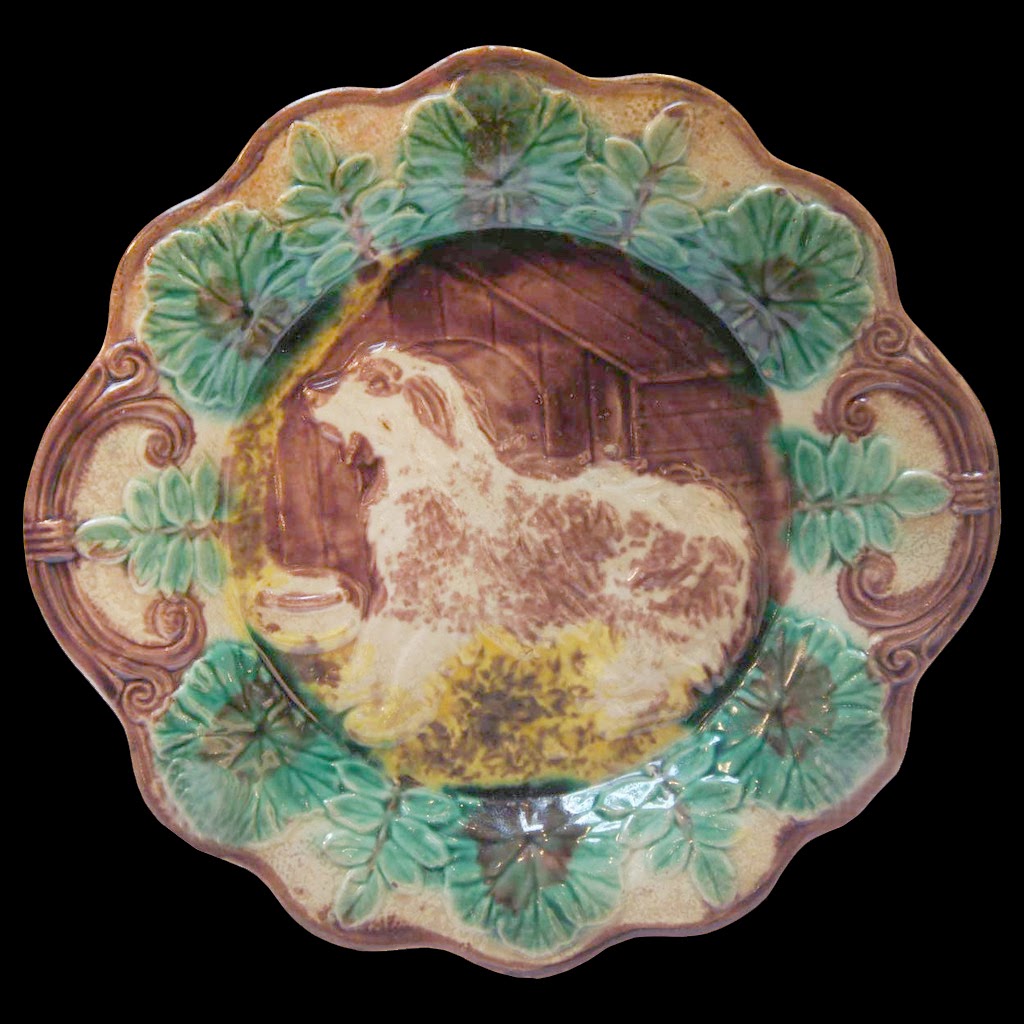
5) Arsenal Pottery Dog Plate
These have been around for only a few years and are some of the most difficult to detect of all the recent reproductions. The glazing is almost identical to the antique plate both front and back.
How to tell:
The easiest way to detect the reproductions is through the obverse glazing. It is often too precise, particularly the glazing of the green leaves around the perimeter. The modeling of the leaves is thick and clumsy. The ground is also white, opposed to the ivory color on the antique.

Arsenal Pottery majolica dog plate

Reproduction dog plate

6) Arsenal Pottery Hunting Dog and Stag Plate
These reproductions appeared at the same time as the Toby and Homestead plates and are clearly being made by the same manufacturer. Arsenal made two versions of this plate—one with handles on the perimeter and one without. The plate without handles is the one being copied.
How to tell:
Reverse glazing is identical to the antique but they chose to cut corners in glazing the front of the plate. Instead of using multiple colors to indicate the dog and the deer, it is usually a solid color like the Toby plate.

Arsenal majolica dog and stag plate

Reproduction Arsenal hunting dog and stag plate

7) Minton, Etruscan, Wedgwood, George Jones and Forester Cheese Bells
These reproduction cheese keepers have been around for years yet they continue to fool people into believing they are antique. The high price they bring is only an incentive for manufacturers to create more.

a. The Minton bee skip cheese bell
Once you've seen an authentic Minton cheese bell, the reproduction becomes obvious. Unfortunately, these fool people who don't know much about majolica. 
How to tell: 
The easiest way for the novice to tell the difference is through the two bases which share nothing in common. Beware the lid sold without a base which is often done to deceive.

Antique Minton cheese bell 

Minton antique cheese bell base

Reproduction majolica cheese bell

Reproduction Minton cheese bell base

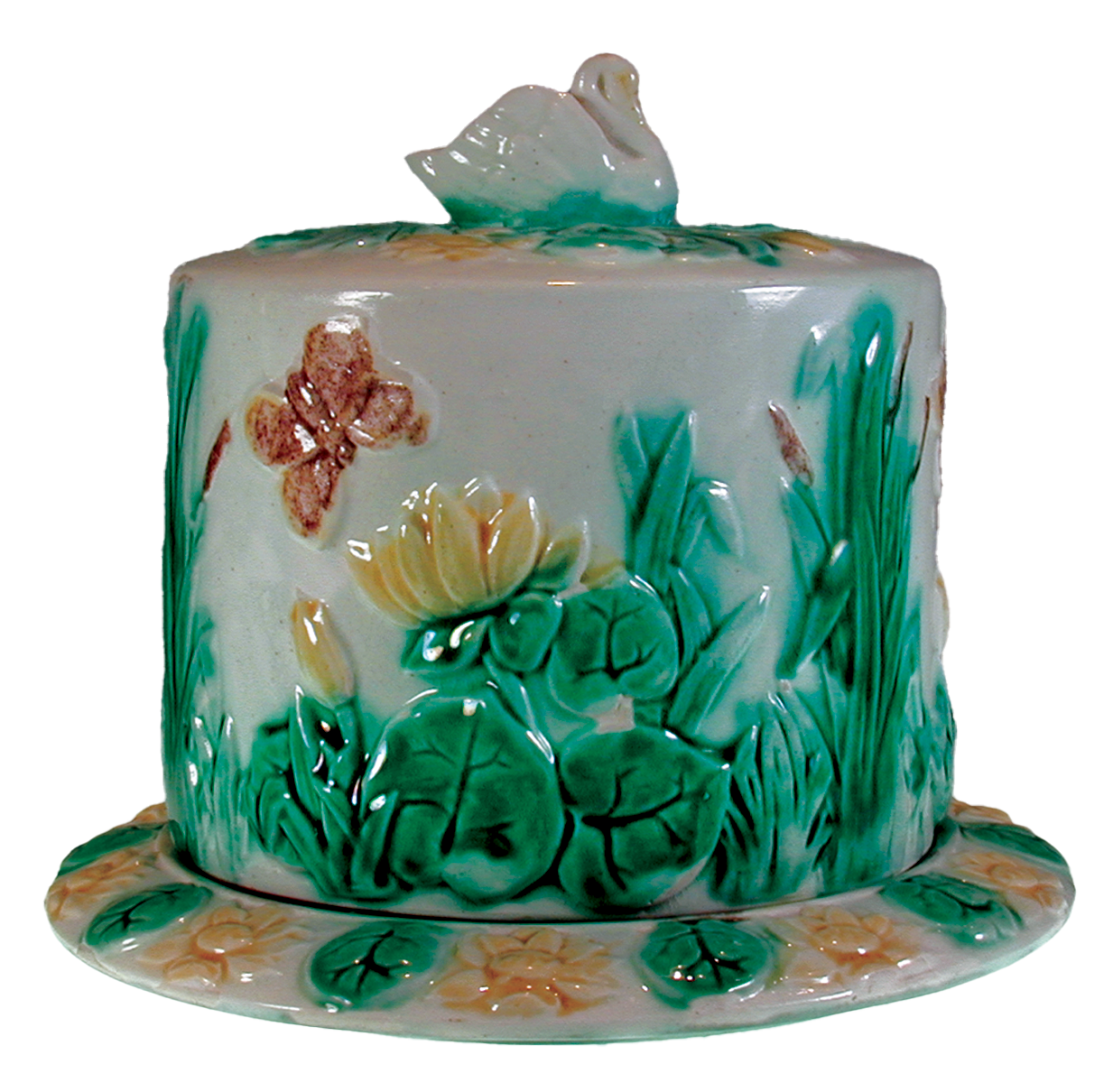
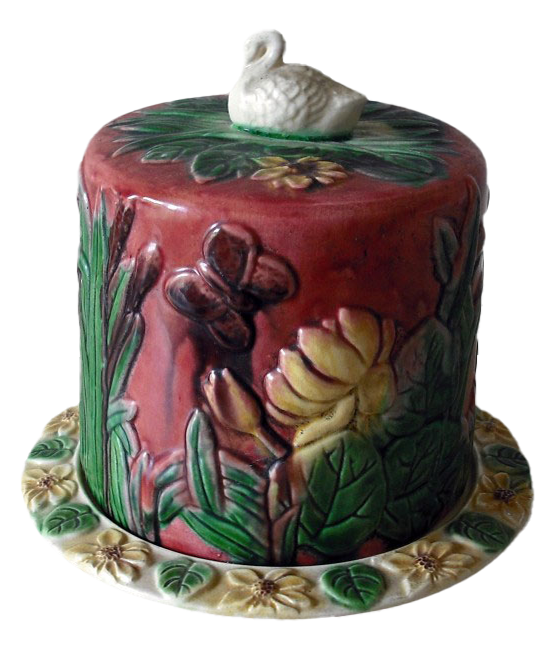
b. Etruscan Lily cheese bell
One of the oldest reproduction cheese bells is that of the Etruscan Lily swan finial cheese bell. 
How to tell:
Authentic Etruscan cheese bells are usually ivory. On rare occasions they can be found in other ground colors. The reproductions are a dark rose color, smaller, more narrow and more crudely modeled. The bases are often not glazed.

Etruscan Majolica Lily cheese bell
Reproduction Etruscan Lily cheese bell

c. Wedgwood majolica floral garland cheese bell
Another cheese bell that has also been available for quite some time. 
How to tell:
There are two versions of this reproduction now being made. Aside from the terrible sloppy glazing of the reproduction, one of the modern cheese keepers has a pointed finial rather than the cheese slice that is the finial on the antique. The second, and most recent, has added a cheese slice but the poor quality of the glazing is still a dead giveaway.

Antique Wedgwood majolica cheese bell

Reproduction Wedgwood cheese bell

An alternate version of the reproduction Wedgwood cheese bell

d. George Jones majolica fence and daisy cheese bell
Another cheese bell that has been in production for at least 20 years, this one unfortunately has three different reproductions available. The more recent reproduction is better than the first two but they're all bad.
How to tell:
The original antique Jones cheese bell has impeccable glazing and clear beautiful glazes. The reproduction glazes are muddy and runny.

George Jones antique cheese bell

Reproduction George Jones cheese bell

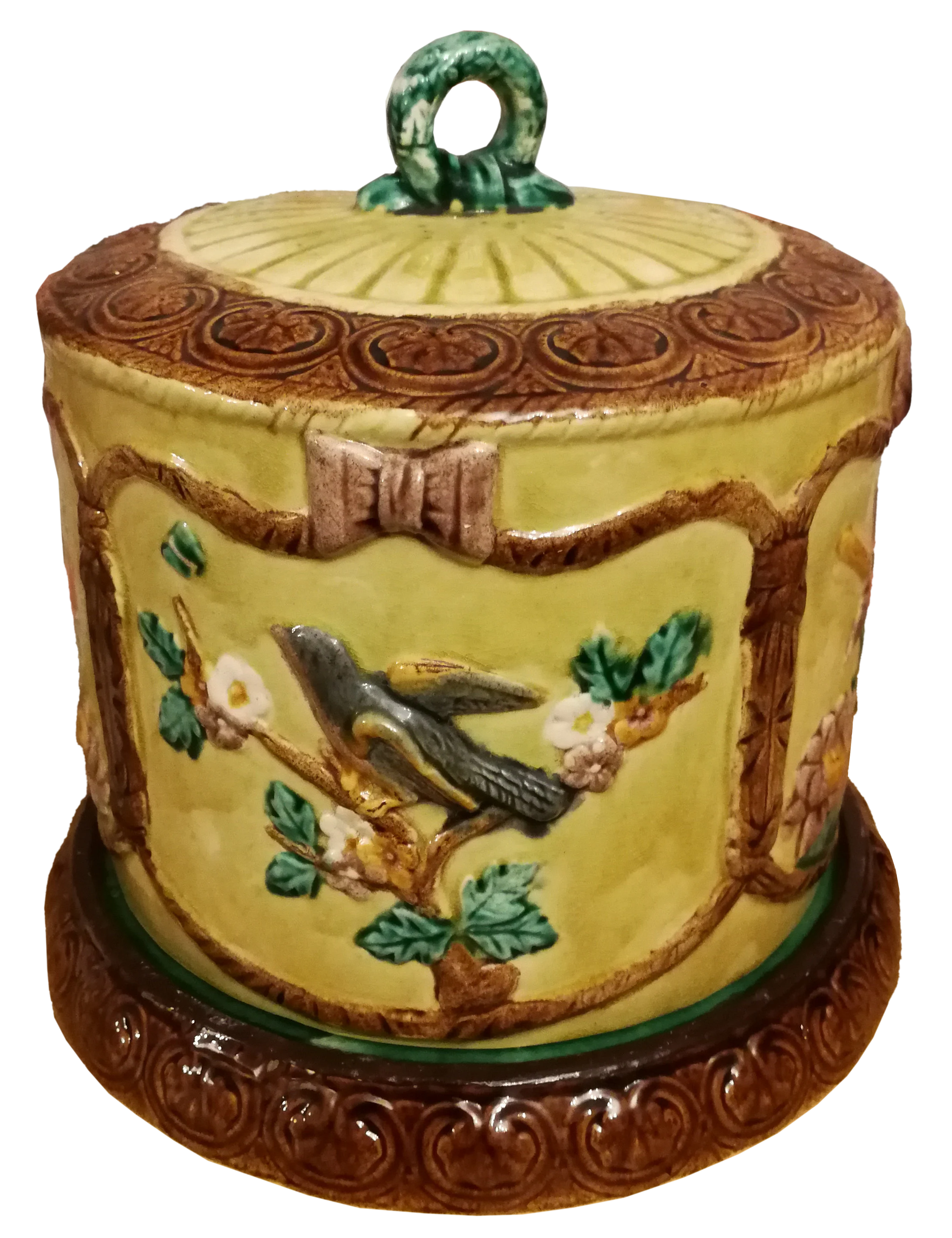
e. Forester majolica bird and rope cheese bell
A relatively easy to find antique cheese bell, this reproduction has only been available for about 10 years.
How to tell:
The glazes in the reproduction Forester cheese bell are unappealing, uneven and often runny. It's also not as colorful as the original.

Antique Forester majolica cheese keeper

Reproduction Forester cheese bell

8) Arsenal Pottery Blackberry Plate
A commonly found majolica plate, this blackberry plate is being reproduced by several modern potteries.
How to tell
It's actually rather easy to tell reproductions from antique plates by the colors and the craftsmanship. The Arsenal originals are generally poorly crafted with muddy glazes. The new plates are tightly glazed with bright colors.

Victorian Arsenal majolica blackberry plate

Reproduction blackberry plate

Reproduction blackberry plate

I wonder how these reproductions will affect the future of the business. Eventually, those of us who know the reproductions purely based on experience will be gone while these things will continue floating around fooling new generations of collectors and scholars and damaging the integrity of future collections in this form. If you doubt their ability to deceive the experts, one only need look at the Majolica Mania exhibition catalog created by Bard College that has a modern Etruscan asparagus mug with a fake mark from the collection of the Chester County Historical Society Museum shown as antique.

There are many other reproductions circulating through the resale market. I have written about them in this blog over the years as I've come across them. I recommend that you use the search engine in the top left corner on this page to read some of the other blog posts. 

In closing, the only real guarantee of buying authentic antiques is through exposure, education and buying from reputable dealers. A bargain is usually not much of a bargain in the long run. You usually get what you pay for.