A look at the design, market and legacy of Victorian pottery

Friday, February 16, 2018

Minton in the Movies

Some time ago I did a post of Majolica in the Movies over a piece of majolica I perceived to have been used in the movie Pillow Talk. What I somehow managed to miss in that post though was two pieces of Minton used earlier in the same film. Oddly enough they are the same pattern piece also used in the movie What Ever Happened to Baby Jane— the Minton Thorwaldsen jardiniere—although in Baby Jane only one is shown. Whether either of the pieces used in Pillow Talk are the same exact piece used in What Ever Happened to Baby Jane there is no way to know for sure but it appears that the center medallion in those used in Pillow Talk have birds in them whereas the one used in Baby Jane looks like a landscape similar to the one shown below, but there is a case for saying it's possible.

Scene from Pillow Talk showing the Minton Thorwald jardinieres

Scene from Baby Jane showing the Minton
jardiniere on the dresser in the background

“But ya are Blanch, ya are in that chair”

Pillow Talk and What Ever Happened to Baby Jane were made around the same time, Pillow Talk in 1959 and What Ever Happened to Baby Jane in 1962. One movie was filmed in color and the other in B&W so glaze colors can’t help in the identification, but both movies were independent productions filmed in Hollywood so they were each free to draw upon the same studio prop resources. In Pillow Talk the pair of jardinieres are part of the inventory of a decorating firm. In Baby Jane one sits on Blanche Hudson’s dresser.

Minton Thorwaldsen jardiniere

Another piece of Minton majolica shows up in the movie Rhapsody in Blue. It is the Minton mermaid centerpiece Flower Bearers. 

Minton majolica Flower Bearers

Scene from Rhapsody in Blue

Purchased by Warner Brothers from a California estate in the 1940s, the piece appears on George Gershwin’s mantel in the film. The same piece was later used in the movie Annie on a table in Daddy Warbucks’ home. The story of this Minton centerpiece is a tale unto itself.

Scene from Annie

Another piece of Minton appears in Annie as well, a Minton pedestal, shown briefly in a bathroom

Scene from Annie

Minton majolica pedestal

An identical pedestal in a brown ground appears in the movie The Normal Heart.

The Normal Heart

It’s not uncommon for movie props to show up in numerous productions. The majolica clock that appears in Gigi (1958) also appears in David Copperfield (1936), In the Good Old Summertime (1947), Time Machine (1960) and several westerns. The antique boat bed in Sunset Boulevard (1950) was also used in several movies: Trifling Woman (1922); The Phantom of the Opera (1925); Twentieth Century (1934); and Good Neighbor Sam (1964).

Scene from Gigi showing the frequently used majolica 
clock in the background.


Majolica clock in David Copperfield (1936)

Antique bed built for entertainer Gaby Deslys. 
It that has appeared in multiple movies


Scene from Twentieth Century showing the antique bed in the background

Scene from Sunset Boulevard that features the antique bed shown above

It's also common to see the same sets used in different movies. The extravagant Victorian staircase built for The Magnificent Ambersons (1942) was also used for the Cat People (1942), The Falcon in Danger (1943), and The Spiral Staircase (1946). Another stair, the prominent, ever changing staircase in the film Auntie Mame (1958), appeared in at least fourteen other films! There’s an entire blogging industry behind searching out props and locations appearing in multiple movies. One of my favorite blogs of this kind is Recycled Movie Costumes which furnished a couple of the images used in this article.

Should you see the Thorwaldsen jardiniere or the Flower Bearers in any other mid-century movie please let me know and I'll post it here.

Monday, January 15, 2018

Majolica Clocks

French majolica case made for New Haven Clock Co.

Ceramic clocks have a long history in European ceramics dating to Meissen's elaborate porcelain clocks of the early 18th Century. This tradition continued particularly in Germany and France through the last half of the 19th Century and the period of majolica manufacture. Elaborate clocks and matching garniture sets were extremely popular on the continent from the Belle Epoch to the early deco period. While there are examples of British and American clocks from the period, this was an area where continental majolica dominated. Wasuel, the Barbotine manufacturers, Dreyfuss, Sarreguemines, Massier and Choisy-le-Roi all contributed to the output. Some also made stands for gentlemen’s watches. I have included these as well.

Massier majolica iris clock
Massier majolica pansy clock
Massier majolica bird and floral clock
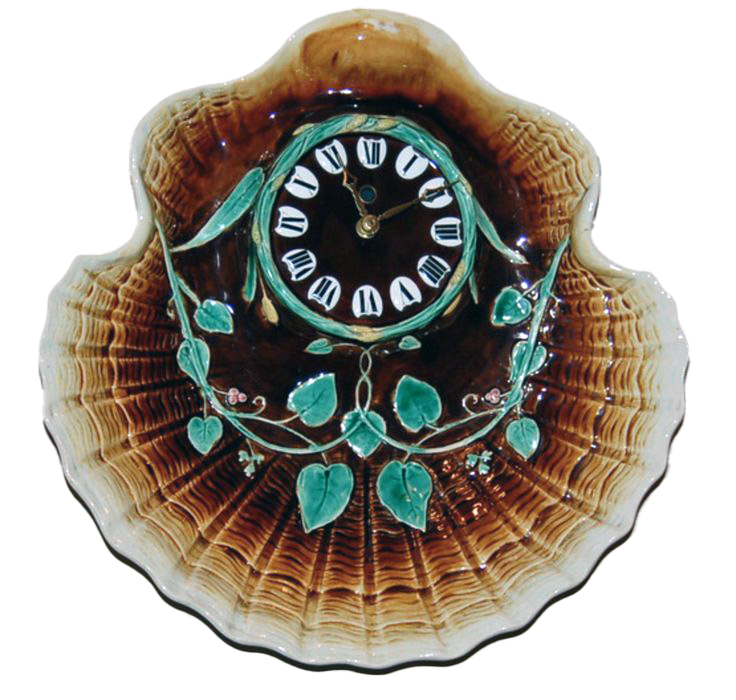
This Choisy-le-Roi shell clock repurposed the tray
from one of their food servers

Sarreguemines majolica clock

French Barbotine majolica clock
Barbotine floral majolica clock
E. Gilles Barbotine clock

Barbotine majolica garniture set
Wasmuẽl majolica clock
Wesmuël garniture set
Sergent majolica wall clock

Sergent majolica wall clock
Les Amis French majolica clock

Georges Dreyfus majolica clock case 
made for the New Haven Clock Works
Georges Dreyfus majolica clovk
Georges Dreyfus majolica watch stand
Choisy-le-Roi majolica clock

Choisy-le-Roi majolica rooster clock
designed by Robert Louis Carrier Belleuse

Gien majolica clock

Lonitz, Schiller and Eichwald and other potteries of Bohemia all had their own take on the clock form.

Lonitz majolica clock and thermometer
Lonitz stag clock
Austrian majolica wall clock and thermometer
Continental majolica clock in the Barbotine style
Lonitz majolica clock
Palissy type continental majolica clock
Strnact majolica clock
Austrian majolica Brownie clock
Karlsruhe majolica clock
Continental majolica mantle clock
Eichwald majolica clock
Schiller & Son majolica garniture set

The English and American potters also made clocks. Of the American manufacturers, Haynes made and manufactured a number of different models of mantle clocks and garniture sets. The New Haven Clock Works sold a number of majolica clocks using their own movements; the majolica cases however were imported from France.
Minton majolica clock
Wedgwood majolica clock
George Jones majolica watch stand

Haynes clock in the Barbotine style
Haynes majolica mantle clock 
Haynes majolica clock
New Haven Clock Works clock in French majolica case

Clock collecting is a specialty area that attracts more general clock collectors than majolica collectors. This has kept the price of most pieces reasonable.

Thursday, December 14, 2017

2017 Year End Wrap-Up


For the first time in ten years there appears to be an improvement in the antique market. While Victorian and earlier antiques remain fashionably outdated for the millennial home decor buying market there seems to be a small uptick in the popularity of older pieces–that is those that fall outside of the popular mid century ware that has dominated the market. This isn't to say that the popularity of the English and French country decor that supported the flourishing of the antique market during the past 35 years has returned because it hasn't, but the austerity of modern design has started to break.

I first noticed this while looking through Country Living Magazine's "40+ Elegant and Easy Thanksgiving Table Settings" last month. A number of table settings include antique china to compliment the modern china that make up the majority of the place settings. In Country Living's December "50+ Christmas Table Settings and Centerpieces." barely a piece of antique china  can be seen among the table settings, but antique china is starting to creep back into the rooms featuring the layouts. Antique glass, flow blue and Jadite appear in the display rooms. The sole use of antique china in the form of red transfer china can be seen in one of the table settings. Majolica, which used to dominate theses layouts, is nowhere to be seen. Country Living magazine declared exclusive antique spaces –as in mid century modern recreated spaces– as one of their "out" trends. They also declared that the popularity of neutrals such as beige and grey as another "out" trend with bright colors and jewel tones a new "in" trend. This supports the Pantone color forecast for 2018 which calls for cerulean blue, green, Tuscan red, violet, teal and turquoise to dominate 2018 decor.

The prices on antiques seem to have bottomed out. While the price of antiques are nowhere  near what it was before the financial collapse of 2007, the decline seems to have stopped. The recent adage "If it's brown it's down," still remains true for furniture but things may be turning around. Antique furniture has a significantly smaller market than it did just ten years ago but like everything else these prices are cyclical and are expected to rebound. Bloomberg encourages buying fancy English and French furniture right now for investment because of their current low prices.

Small antiques stores unfortunately seem to be going the way of mom and pop stores everywhere. Antique malls, auctions and online buying seem to be the wave of the future

The prices on majolica and other antique smalls has also finally steadied after ten years of relentless declines. A survey of general antiques auctions across the past few months support that conclusion. Specialty auctions have also become more competitive with good pieces bringing reasonable but not outrageous prices. Among smalls, antique art and jewelry still bring the highest prices in the secondary market with decorative arts at the low end.

So where does that take us in the individual markets going into 2018? Barring another recession or devastating national disaster the prices should continue to slowly climb upwards. English majolica continues to dominate the market as it always has but some American and French pieces have brought good prices this year as well.

George Jones and Minton majolica have dominated the English majolica market as they always have with Wedgwood and Holdcroft bringing up the rear. The correction of the market has finally made many of these pieces affordable again for the mid range collector. Animal bottles and pitchers continue their reign over the animal majolica market with prices remaining steady.  Humidors too remain popular with good prices across the board. The market for match strikers, butter pats and smokers has largely collapsed.

In all, things are looking good at this point in time for collectors. Bargains are available and this is the time to take advantage of the low prices and strong availability.