A look at the design, market and legacy of Victorian pottery

Sunday, February 27, 2011

Majolica Spotlight: Minton Majolica Tiles


A number of companies made majolica tiles in the last part of the Nineteenth Century and the first part of the Twentieth Century but without question, tiles from the Minton factory were the finest.


History

Minton first showed majolica tiles at the great 1851 Crystal Palace Exposition. There, at the Mediaevil Court they furnished the tiles for the great stove of John Hartman & Co. Designed by Augustus Pugin, they caused a sensation. After Pugin’s death the following year they continued manufacturing tiles based on his designs in the gothic style as well as other styles.

John Hardman & Co stove at the 1851 Crystal Palace Exposition

Minton produced tiles under a number of different names including: Minton & Co.(floor tiles until 1868 then wall tiles), Minton, Hollins & Co. (wall tiles), Mintons Ltd. The tile factory was separately housed from the pottery factory run by two of Minton's nephews, Michael Daintry Hollins and Colin Minton Campbell.

Minton-Hollins tile display at the 1876 Philadelphia Exposition.


The history of the tile works is a complex one with acrimony arising between the two cousins after 1868 when the tile business split from the pottery entirely with one cousin maintaining ownership of the tiles works and one the pottery. Ownership of the Minton name was battled over for years until Campbell's death in 1887. At this point a third relative entered the fray, Robert Minton Taylor who maintained production of tile works under several names, including his own until 1963.

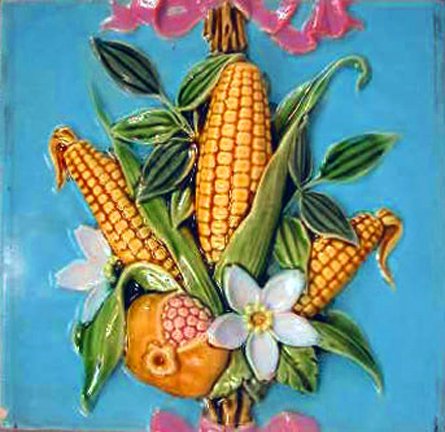
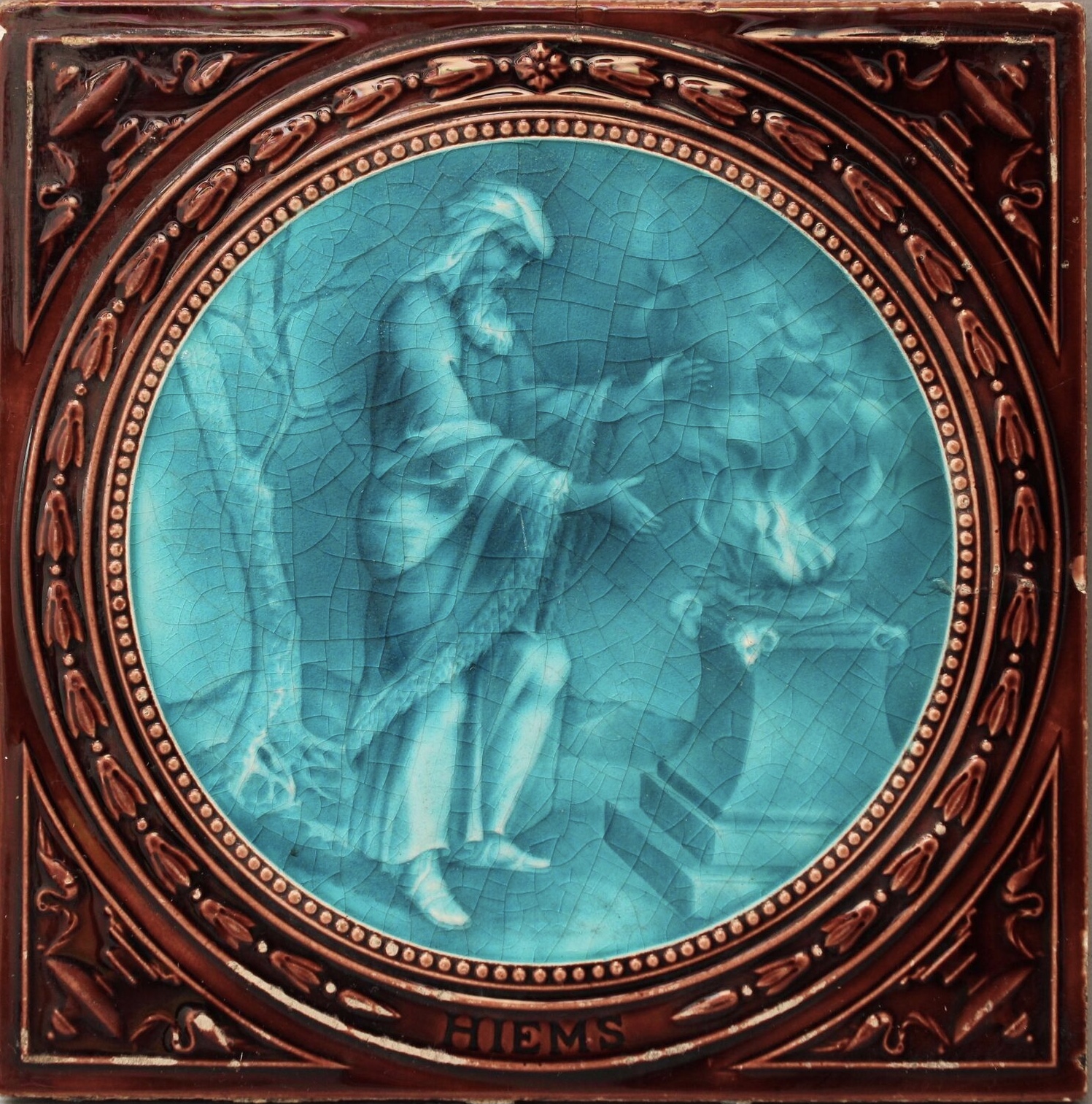
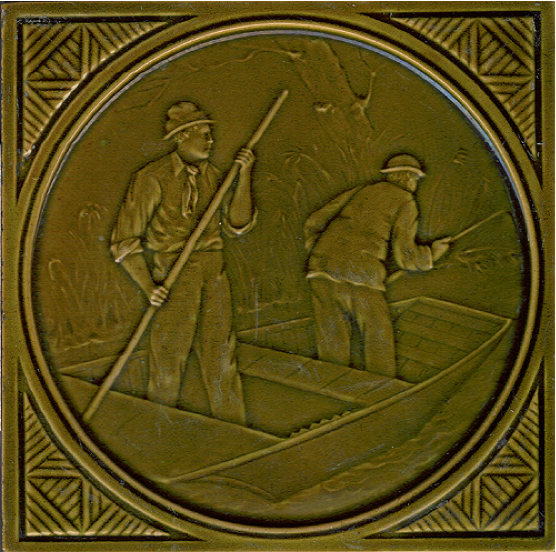
Still, it is the majolica tiles manufactured before Campbell's death that are those most sought by collectors. They can basically be divided into three types: traditional three-dimensional or sculptural majolica, called “embossed” by the company; tube-lined majolica; and pictorial majolica. A fourth type of majolica tile--those monochromatic tiles with transfer or hand painted decoration--aren't included here because they lack high relief, the three-dimensional quality that makes victorian majolica as popular as it is.
For the same reason that majolica was never used for dinnerware, decorative majolica tiles were deemed to be too soft to hold up to the rigors of daily use as floor tiles. Most majolica tiles were instead used on walls and decorated surfaces while encaustic or dust pressed tiles were used for the elaborate floor decorations Victorians favored.

These tiles were almost always marked on the reverse with the Minton mark.


Reverse of Robert Minton Taylor tile
Traditional Victorian Majolica:

Made in a number of different styles these tiles approximate the type of majolica processes that were then being used in Minton majolica pottery. These tiles have a deep three-dimensional field and are in quite a bit of demand by collectors. Some, like the corn tile, bring many hundreds of dollars in the marketplace.


Tube-Lined Majolica

The most commonly found majolica tiles are the tube lined tiles. Tube Lined has a raised clay outline applied with the areas in between filled with majolica glazes, much like cloisonnÄ— or like a coloring book. These are the most reasonably priced tiles available with huge quantities having been produced in the art nouveau style.

Minton majolica Prosser patent tile. Prosser tiles were made by a unique
dust-pressed process that differentiated them from conventional majolica tiles.


Reverse of Minton majolica Prosser tile
Minton Secessionist Ware tile

Pictorial Majolica

These tiles are sculptural in character with many of them representing historical events or mythological figures. These are generally monochromatic in color with high relief allowing the transparent quality of majolica glaze to accentuate detail through the pooling of glaze in the crevices of the design. Those with intricate modeling and desirable subjects usually bring high prices at auction though not generally as high as the traditional majolica tiles. The simpler ones were often used to break up large expanses of field tile by adding a simple decorative element without the addition of a second color. These are usually the least desirable of all Minton majolica tiles and sell quite inexpensively.

Design for tile by E, Welby Pugin

Catalogs

The Minton tile works sold many tiles through catalogs. Fortunately some of these have survived to give us a good idea of how they were used.


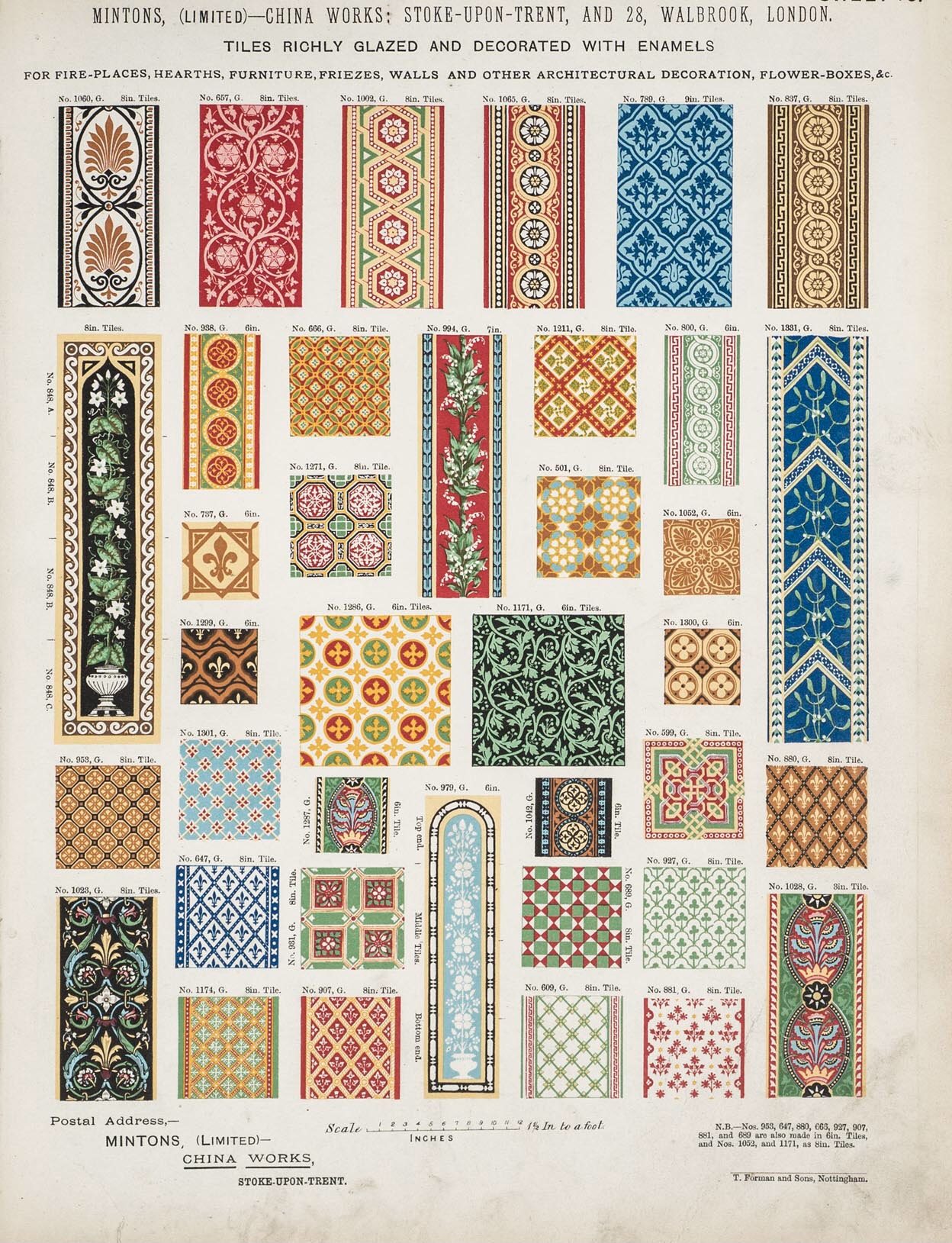


Buying Minton Tiles

Tile can be broken down into two basic types: decorative tile and field tile. Those that I've featured here are all decorative tile. Field tiles are those plain color tiles that make up the bulk of tiled surfaces.
As mentioned earlier, the majolica tiles that have 3-dimensional fields, the embossed tiles, and a great deal of color are those most in demand and those that command the highest prices, some commanding many hundreds of dollars. The tube lined tiles are the most common and as such can be found quite reasonably. 

When buying tiles check the corners most of all. Many tiles are reclaimed; those salvaged from old buildings. These are most likely to have damage and should be carefully examined before buying. Some collectors do not mind buying tiles that have damage as long as it is in an area not visible from the front. Many tiles are also sold in frames. These too should be carefully examined in  the back to check for repair before buying.  Like any other type of majolica, tiles with repair will bring lower prices than those without.

If you would like to view the Minton Tiles Pattern Book go here and here.

If you would like to download a PDF of  the 1909 Minton Tiles Pattern Book go here.

Saturday, February 19, 2011

Presidential Majolica

In honor of President's day I thought I'd highlight some presidential connections to majolica.

Presidents Garfield, Washington and Lincoln have all appeared on English majolica pieces made for the American market. The most famous of these is probably the Wedgwood Centennial pitcher.

Wedgwood majolica Presidents Jug

Wedgwood majolica Presidents Jug

Wedgwood made a number of pieces featuring American presidents in various bodies including a Black Basalt ceramic bust of Lincoln, but the only piece I know of made in majolica is the Washington/Lincoln Centennial pitcher. Featuring a cameo portrait of Washington on the one side and a portrait of Lincoln on the other, the pitcher was potted in 1876 to commemorate the 100th anniversary of the United States' independence from Great Britain. Most likely created for the 1876 World's Fair in Philadelphia it was made in a number of different color combinations including cobalt and Argenta.


Other companies made presidential majolica too. This Copeland piece was also created for the Centennial celebration. It features Washington on the one side and the crossed flags of the United States on the reverse.
Reverse of above pitcher

When President Garfield was assassinated in office in 1881 it inspired a number of majolica memorial pieces including the Wardle pitcher below.

Wardle President Garfield memorial pitcher

There was also a large majolica memorial plaque made for President Garfield.

Garfield memorial plaque

An unknown potter created this presidential pitcher below. There is some dispute as to whether this is a Garfield memorial pitcher or a portrait of Ulysses Grant, though it looks like Garfield to me. The only thing that is agreed on is that it is definitely a US president. 


One of the more unusual Presidential majolica items I've seen is this unmarked majolica William McKinley jug with McKinley posed as Napoleon. It is based on porcelain campaign jug made by Morris & Willmore.

President McKinley posed as Napoleon

The German/French company Sarreguemines known for their majolica made a series of transfer earthenware plates of American presidents

Transfer earthenware Sarreguemines Washington plate

Transfer earthenware Sarreguemines Pierce Pate

Transfer earthenware Sarreguemines plate

Transfer earthenware Sarreguemines Garfield plate

A German company made a tray in the 1890's commemorating Lincoln’s first Vice President, Hannibal Hamlin    

Portrait tray of Hannibal Hamlin

Another piece from Germany done in the intaglio style is this plate of Grover Cleveland.


Grover Cleveland plate

Numerous tile companies, both American and English, made tiles with Presidential images, all in the majolica intaglio process. There was even one with Martha Washington!

George Washington tile by Beaver Falls, Pa. Tile Co.

George Washington tile by Beaver Falls, Pa. Tile Co.

Ulysses S. Grant by A.E.T. Tile Co.

Benjamin Harrison by C. Pardee Works, c 1888

Benjamin Harrison tile 

Garrett Hobart, Vice Presidential candidate, c.1888

Grover Cleveland, J.G. & J.F. Low Art Tile Works, 1885

Grover Cleveland tile, C. Pardee Works, c.1888

William McKinley tile, American Encaustic Tiling Co., 1896

Theodore Roosevelt tile, Barratt Tile Co.1916

Woodrow Wilson tile, Barratt Tile Co, 1916

Martha Washington by Beaver Falls Tile Co., Pa.

Majolica with presidential connections would include this service of oyster plates of 1880 Haviland porcelain with a majolica glaze from President Rutherford B. Hayes' time in the White House.


Also, in the White House Lincoln bedroom sits a wonderful Brown, Westhead Moore passion flower jardinière. Whether this actually has a presidential provenance or not, it is entirely appropriate to the period setting.

Lincoln bedroom Photo: c.2005

Brown-Westhead Moore majolica passion flower jardiniere

This majolica jug by Peters & Reed of Zanesville, Ohio bears the likeness of President Lincoln on one side and President Washington on the other.

Peters & Reed Lincoln/Washington jug

This unusual toby jug of President McKinley was made by the Bennett Pottery of Baltimore to commemorate the 1885 McKinley tariff which attempted to make American pottery competitive with inexpensive imported goods. McKinley is sitting on a stack of money holding the 'McKinley Bill" with McKinley's campaign slogan "Protection" and "Prosperity" on either side of the base. It was a copy of an unmarked porcelain jug. Unfortunately it all was for naught with the passing of the Wilson-Gorman Tariff act nine years later which removed all tariffs from imported pottery and effectively sounded the death knell for American pottery manufacturers .

Bennett Pottery majolica McKinley toby jug

Bennett Pottery McKinley toby jug

Finally, we have two pieces of ironstone with a presidential portrait and its own majolica connection.
This campaign piece featuring President William McKinley was made by the Chester Pottery, the former Etruscan Works of Phoenixville, Pennsylvania, in two shapes. One shape was the same as that used on the Etruscan Baseball jug.


This blog post has been edited since it was originally posted.