A look at the design, market and legacy of Victorian pottery

Saturday, February 19, 2011

Presidential Majolica

In honor of President's day I thought I'd highlight some presidential connections to majolica.

Presidents Garfield, Washington and Lincoln have all appeared on English majolica pieces made for the American market. The most famous of these is probably the Wedgwood Centennial pitcher.

Wedgwood majolica Presidents Jug

Wedgwood majolica Presidents Jug

Wedgwood made a number of pieces featuring American presidents in various bodies including a Black Basalt ceramic bust of Lincoln, but the only piece I know of made in majolica is the Washington/Lincoln Centennial pitcher. Featuring a cameo portrait of Washington on the one side and a portrait of Lincoln on the other, the pitcher was potted in 1876 to commemorate the 100th anniversary of the United States' independence from Great Britain. Most likely created for the 1876 World's Fair in Philadelphia it was made in a number of different color combinations including cobalt and Argenta.


Other companies made presidential majolica too. This Copeland piece was also created for the Centennial celebration. It features Washington on the one side and the crossed flags of the United States on the reverse.
Reverse of above pitcher

When President Garfield was assassinated in office in 1881 it inspired a number of majolica memorial pieces including the Wardle pitcher below.

Wardle President Garfield memorial pitcher

There was also a large majolica memorial plaque made for President Garfield.

Garfield memorial plaque

An unknown potter created this presidential pitcher below. There is some dispute as to whether this is a Garfield memorial pitcher or a portrait of Ulysses Grant, though it looks like Garfield to me. The only thing that is agreed on is that it is definitely a US president. 


One of the more unusual Presidential majolica items I've seen is this unmarked majolica William McKinley jug with McKinley posed as Napoleon. It is based on porcelain campaign jug made by Morris & Willmore.

President McKinley posed as Napoleon

The German/French company Sarreguemines known for their majolica made a series of transfer earthenware plates of American presidents

Transfer earthenware Sarreguemines Washington plate

Transfer earthenware Sarreguemines Pierce Pate

Transfer earthenware Sarreguemines plate

Transfer earthenware Sarreguemines Garfield plate

A German company made a tray in the 1890's commemorating Lincoln’s first Vice President, Hannibal Hamlin    

Portrait tray of Hannibal Hamlin

Another piece from Germany done in the intaglio style is this plate of Grover Cleveland.


Grover Cleveland plate

Numerous tile companies, both American and English, made tiles with Presidential images, all in the majolica intaglio process. There was even one with Martha Washington!

George Washington tile by Beaver Falls, Pa. Tile Co.

George Washington tile by Beaver Falls, Pa. Tile Co.

Ulysses S. Grant by A.E.T. Tile Co.

Benjamin Harrison by C. Pardee Works, c 1888

Benjamin Harrison tile 

Garrett Hobart, Vice Presidential candidate, c.1888

Grover Cleveland, J.G. & J.F. Low Art Tile Works, 1885

Grover Cleveland tile, C. Pardee Works, c.1888

William McKinley tile, American Encaustic Tiling Co., 1896

Theodore Roosevelt tile, Barratt Tile Co.1916

Woodrow Wilson tile, Barratt Tile Co, 1916

Martha Washington by Beaver Falls Tile Co., Pa.

Majolica with presidential connections would include this service of oyster plates of 1880 Haviland porcelain with a majolica glaze from President Rutherford B. Hayes' time in the White House.


Also, in the White House Lincoln bedroom sits a wonderful Brown, Westhead Moore passion flower jardinière. Whether this actually has a presidential provenance or not, it is entirely appropriate to the period setting.

Lincoln bedroom Photo: c.2005

Brown-Westhead Moore majolica passion flower jardiniere

This majolica jug by Peters & Reed of Zanesville, Ohio bears the likeness of President Lincoln on one side and President Washington on the other.

Peters & Reed Lincoln/Washington jug

This unusual toby jug of President McKinley was made by the Bennett Pottery of Baltimore to commemorate the 1885 McKinley tariff which attempted to make American pottery competitive with inexpensive imported goods. McKinley is sitting on a stack of money holding the 'McKinley Bill" with McKinley's campaign slogan "Protection" and "Prosperity" on either side of the base. It was a copy of an unmarked porcelain jug. Unfortunately it all was for naught with the passing of the Wilson-Gorman Tariff act nine years later which removed all tariffs from imported pottery and effectively sounded the death knell for American pottery manufacturers .

Bennett Pottery majolica McKinley toby jug

Bennett Pottery McKinley toby jug

Finally, we have two pieces of ironstone with a presidential portrait and its own majolica connection.
This campaign piece featuring President William McKinley was made by the Chester Pottery, the former Etruscan Works of Phoenixville, Pennsylvania, in two shapes. One shape was the same as that used on the Etruscan Baseball jug.


This blog post has been edited since it was originally posted.

Saturday, February 12, 2011

The Bethesda Fountain and Terrace

If you ever come to New York City one of the sights you'll want to see as a majolica collector, is the fabulous Bethesda Fountain and Terrace in Central Park.

Angel of the Waters Fountain

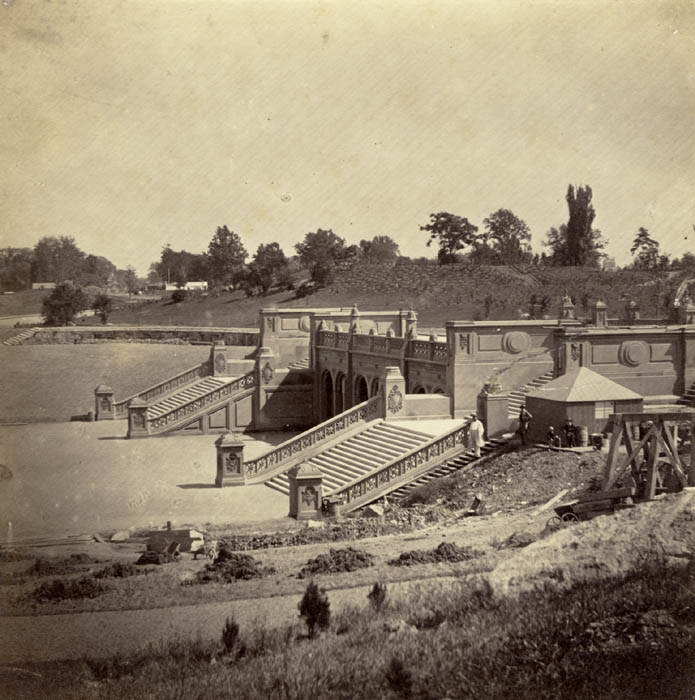
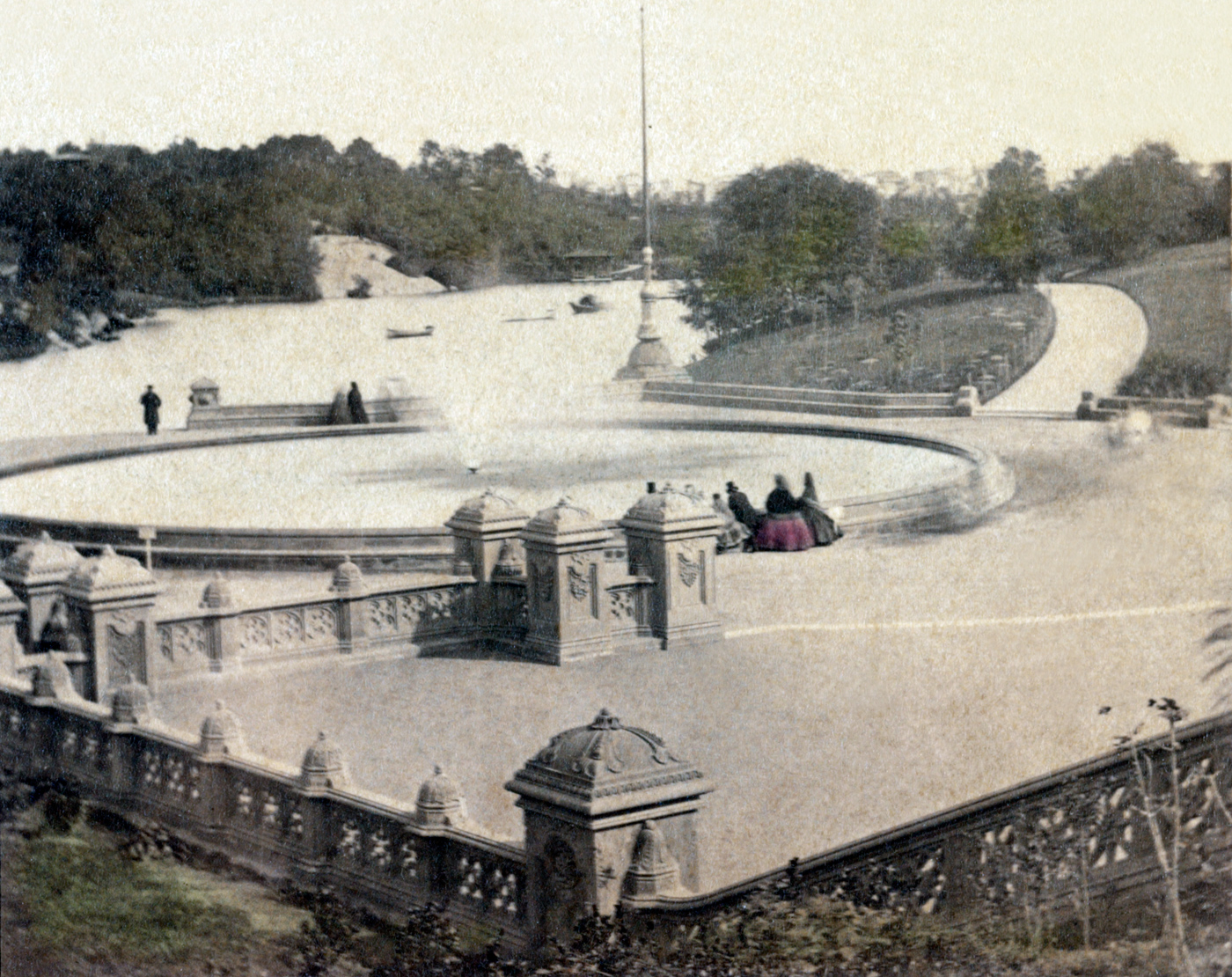
Built at the very height of the Civil War, between 1859-1864, the Water Terrace, as it was called, was designed by Calvert Vaux and Frederick Law Olmstead to commemorate the opening of the Croton Aqueduct which brought water to reservoirs in New York City. Designed to conform to the landscape of the area, the Terrace overlooks the Ramble and the Lake. The two grand staircases leading to the lower level, are adorned with carvings that depict the four seasons with detailed renderings of fruit, flowers, plants, and birds. Originally intended by Vaux to feature a fountain tribute to love, a sculpture by Emma Stebbins, the Angel of the Waters, a tribute to the biblical story of the angel Bethesda, was installed instead.

Water Terrace under construction

Water Terrace before the installation of the Angel of the Waters Fountain

Calvert Vaux

Frederick Law Olmstead

Emma Stebbins, right, and her partner 
Charlotte Cushman, left.

“For an angel went down at a certain time into the pool stirred up the water; 
then whoever stepped in first, after the stirring of the water, 
was made well of whatever disease he had” John 5:4

The ceiling of Minton tile designed by Jacob Wrey Mould, is one of the few great public examples of the use of British Minton tile in the United States.

Jacob Wrey Mould

It was installed in the terrace in 1869 and the fountain of Bethesda and the cherubs representing Temperance, Purity, Health and Peace were added in 1873. It was then that the area took on the name of the Bethesda Terrace.


The two staircases flanking the terrace.

Plaque in Bethesda Terrace

Detail from the terrace by Jacob Wrey Mould

Interior of Bethesda Terrace

Located in the middle of Central Park, the Terrace is located off west 72nd St. between the Breuer Building (the old Whitney Museum of Art) and the Frick Collection on the East side of the park and the fabulous Dakota Apartments on the West side.


The Terrace overlooks the Lake and is built of Brunswick sandstone in a Victorian mix of Romanesque, Gothic and Classical styles. It comprises two levels: the upper Terrace and the lower Terrace. The lower Terrace is where you will find the brilliant 16,000 Minton tiles that cover most of the wall and ceiling surfaces of the underground passageway. Covered in every conceivable kind of tile, primarily encaustic and majolica, the Terrace is one of the great wonders of New York City, a city full of wonders. Visit the official Central Park Web site.


A portion of the ceiling featuring Minton tiles.

We found online a couple of wonderful 360 degree panoramas that allows you to view the underground Terrace as if you were standing right in the center of it. The white arrows link to other panoramas taken within Central Park.

The first link shows the interior of the lower Terrace Arcade in daylight.


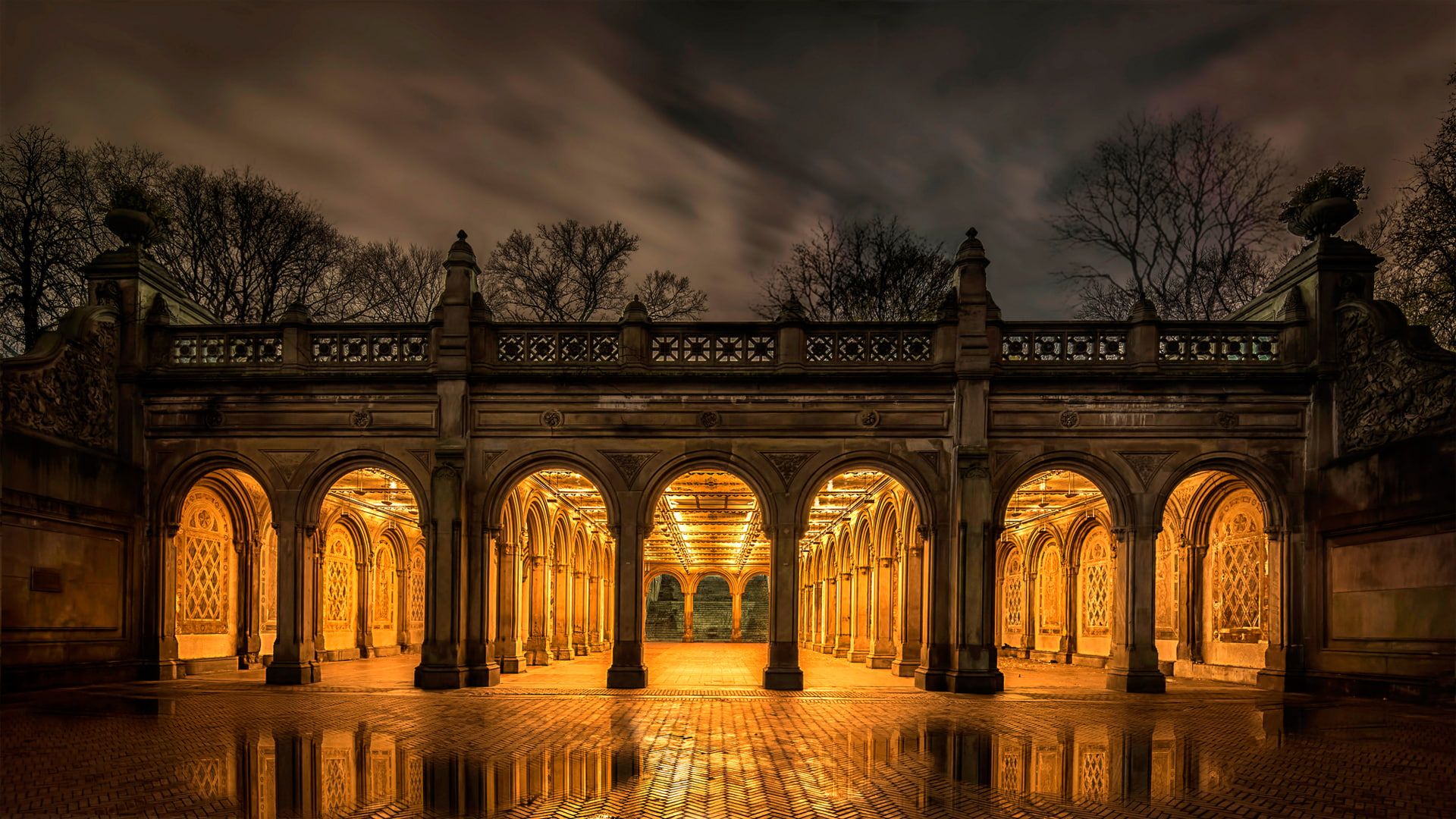
Here is another showing the underground interior Arcade in the Terrace lit up at dusk.


Now somewhat worn by time, it must have astounded visitors when it was first built. 

Arcade of Bethesda Terrace at night

Restored between 1983-2007, it is a marvelous place to spend a quiet afternoon. I feel very lucky to live so close by.

Saturday, February 5, 2011

Etruscan Shell Ice Cream Bowl

In the current issue of Majolica Matters, the newsletter of the Majolica International Society, Wanda Matthes writes about her visit to a majolica collector's home. Part of the article mentions viewing the collector's large Shell collection. As part of that collection Wanda makes a reference to our book, Etruscan Majolica, Volume 2.
The reference concerns the Etruscan M-6 Shell bowl.
GSH Shell nappy

Known informally as the Etruscan Shell Ice Cream bowl, the M-6 bowl is one of the most scarce pieces in the entire Shell catalog. An unconventional treatment of the Shell motif, very little is known about the history of the piece. It received the nickname of the ice cream bowl from the late collector Anna Stern who always referred to it in that way. It's entirely possible that she got that name from the former decorators of the Etruscan Works, many who she knew personally, but there is nothing in the surviving literature that backs that up. It is actually rather deep for a Victorian ice cream server. In the 1884 Catalogue of Majolica it is simply referred to as an 8" Shell nappy.


Its presence in the catalog gives us some information as to when it was created but having never seen the bowl in Ivory Ware or Venicine, tends to indicate that it is neither an early design nor a late one. Why it is so scarce is also a mystery. Most information points to the design being one that was discontinued soon after the publication of the catalog. The page on which it is shown was one of those removed from the Catalogue when it was redistributed after the 1884 Fair. Perhaps this is a reason why.

The bowl is generally found in one of two glaze combinations, the traditional one shown above and the green-lined example shown below, which featured mottled shells.

GSH Shell nappy

Because of its scarcity there is no real established price point for the bowl as there is the other Shell bowls. I have seen examples priced as high as $700 and as low as $80. In any event it is a bowl that you as a savvy collector should not pass on should you come across one. You may never see another one again.