
In a previous post I wrote about Wedgwood's famous Ocean pattern. Marine life has been one of the richest sources of subject matter for majolica manufacturers. From the largest manufacturers like Minton and George Jones there's barely a centerpiece or conservatory piece that doesn't reference them. And of course there are the oyster plates!
 Minton majolica putto on hippocampus


 George Jones majolica shell bearers
 Royal Worcester majolica mermaid server


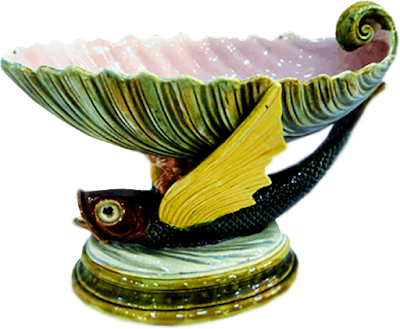
 Minton majolica sweetmeat
From the smaller manufacturers like Fielding, Wardle and the Etruscan Works we have the famous Shell and Net pattern, Shell and Seaweed pattern and Shell series.


 Adams & Bromley majolica fish cheese bell
 Wedgwood majolica hippocampus jug


 Schiller majolica marine ewer
 Unattributed majolica fish tea set




 French majolica Barbizet fish plaque
 Palissy majolica fish basket
 Desvres majolica fish pitcher

Minton monumental centerpiece

Minton majolica putti fountain


Minton majolica putti on dolphin vase

George Jones majolica centerpiece


Luneville majolica centerpiece
George Jones majolica spooner

Choisy-le-Roi centerpiece
Minton majolica putti centerpiece
 Minton majolica fish plate  Forester majolica fish plate  M. S. Kuzniecov majolica shell plate  |
Wedgwood majolica shell pitcher

Sarreguemines majolica vase

Minton majolica crane fountain
George Jones majolica oyster plate

Minton majolica oyster plate

Wedgwood dolphin and shells majolica oyster plate


Etruscan Majolica Shell pattern

Wedgwood majolica Ocean tea set

Wardle majolica Shell tea set

Fielding majolica Shell and Net set
We also have the wonderful Adams and Bromley and Wedgwood fish pieces.
Adams & Bromley majolica fish tea set


Wedgwood majolica flatfish platter

But many beautiful pieces were also created by other potters as well as unknown potteries. These pieces are generally overshadowed by the name potteries in big auctions but many of them are gorgeous in their own right and a great buy.

Shorter & Boulton shells & waves platter

Wardle majolica sardine

Unattributed majolica master salt

Onnaing majolica fish platter

Unattributed shell and seaweed pitcher
Unattributed fish platter
Holdcroft majolica fish plate

Holdcroft majolica terrine

Holdcroft majolica salmon platter

Bevington majolica fish basket


Shorter/Adams & Bromley majolica fish pitcher


Léon Brard Palissy majolica plaque

Léon Brard Palissy fish plaque

French Palissy majolica charger

Renoleau majolica palissy plaque

Thomas Sergent palissy plaque


Holdcroft fish cheese dish

Unattributed fish vase


Majolica triton sweetmeat


Austrian majolica fish humidor


Adams & Bromley shell tazza
The number of different designs is endless and a wonderful legacy left to us by these majolica potters of the 19th century.


