

Today Zsolnay is best known for the brilliant iridescent eosine glazed pottery that is synonymous with its name, but the Zsolnay factory created a wide variety of ceramics during its history including majolica.
The Zsolnay Porcelain Factory was established in Pécs, in the southern part of Hungary by Miklós Zsolnay. Miklós was a salesman who began his career as a merchant selling a variety of different wares in his department store in Pécs. Miklós had two sons, Ignać, born in 1826, and Vilmós, born in 1828. The success of the retail operation encouraged him in 1851 to purchase a nearby architectural manufacturer that specialized in terracotta architectural brick as a business for son Ignać. His other son Vilmós inherited his father’s commercial sales businesses

Ignác who had some training in pottery established his management of the pottery in 1853 and expanded on the base of brick manufacture to include simple tableware, garden ornaments, architectural stoneware tile, stoves and plumbing fixtures. Unfortunately Ignać lacked the business acumen to run the pottery, declaring bankruptcy twelve years into his management. Ignác then left the business selling his interest to his brother Vilmós, and moved to Romania.


Vilmós Zsolnay followed his father into his sales business at his father’s store. After the failure of his brother’s attempt at managing his father’s pottery he took over its management in 1864, purchasing his brother's interest in 1865. Under him the company business grew, relying on his own artistic background to expand into decorative pottery and more elegant tableware. He began to import raw materials from surrounding areas like Croatia and Transylvania as the business expanded. The stove and pipe operations soon separated into their own manufacturing businesses leaving the decorative and tableware unit an opportunity to develop independently.
Vilmós tried to raise the artistic level of the company's output by exhibiting in world exhibitions starting with the 1873 Vienna World's Fair. His first work was strongly inspired by the Orientalist movement. It was at the World’s Fair that he was first exposed to the colorful decorative majolica exhibited by Minton and Théodore Deck.


This encouraged him to develop his own majolica glazes at his Pécs workshop and soon developed majolica with designs based on popular tastes. Persian and Chinese design were the inspiration for much of Zsolnay's early work as was local Hungarian folk pottery. Vilmós’ daughters Júlia annd Térez were instrumental in the development of the company designs in the Japanese taste while classically trained sculptor Ármin Klein brought the western European interest in Renaissance art to the company. Son Miklós, named after his grandfather, toured the middle east and brought Persian and Iznik ceramics back for inspiration before taking control of the company’s business operations.


At the Paris International Exhibition in 1878 Zsolnay made a strong impression in ceramics by exhibiting the company’s original ceramic creations. This won for the company the Gold Medal in its class as well as the Order of Honor of the French government. Their regular use of exhibitions to raise awareness of their work allowed the company to grow exponentially


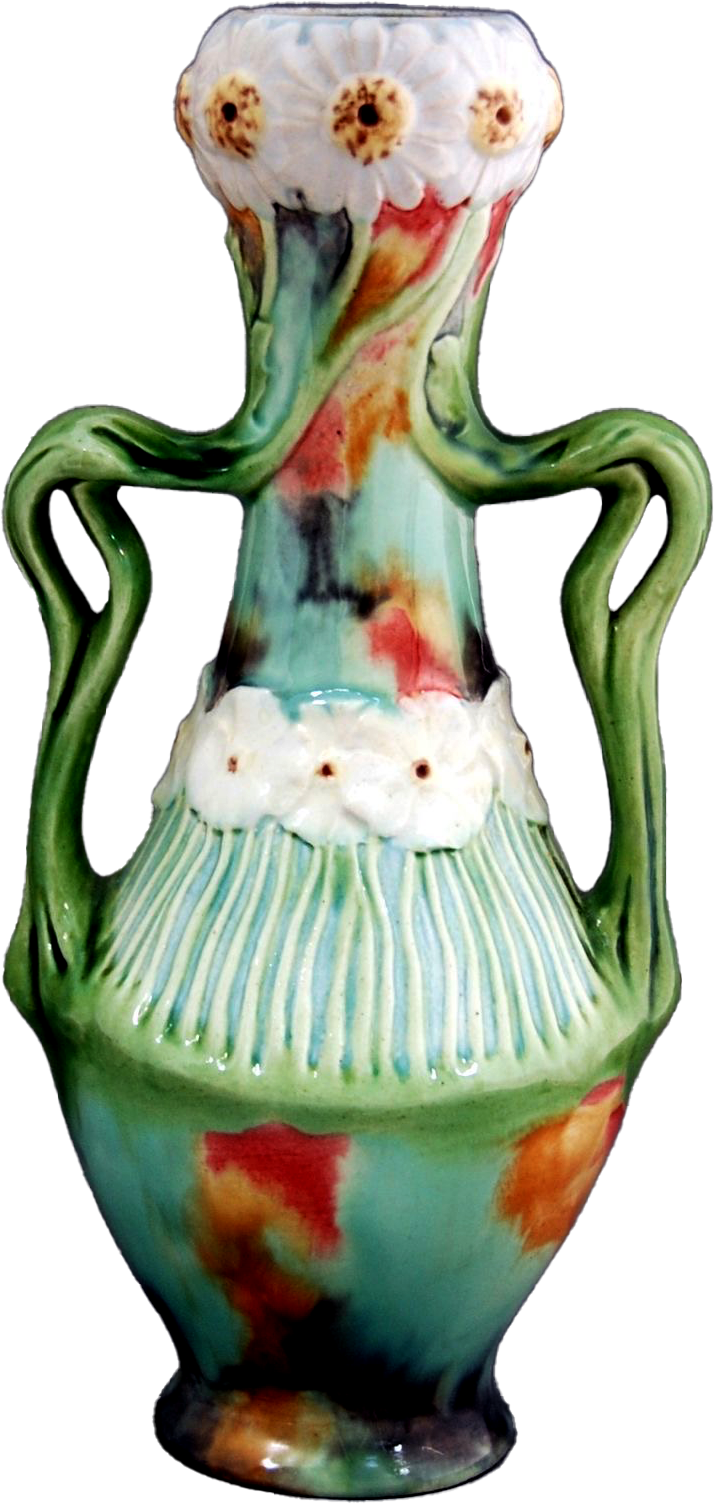


Within a few years the Zsolnay factory became one of the largest potteries in Europe. In 1895 they purchased the second largest majolica manufacturer in Hungary, Fischer Ignác Porcelain in Pest, to completely dominate the market.
Part of that dominance was also a result of the company's architectural tile business. Throughout Hungary colorful Zsolnay pyrogranite majolica tiles decorate the exterior and interior of buildings, bringing brilliant unexpected color to roofs, facades and gardens. Today they are considered an integral part of Hungarian secessionist architecture.


The company interest in Persian and Ilznik pottery led to glaze experimentation that in 1893 brought the development of the eosine glaze that would make the pottery's name. Based on the secret lusterware technology of Fustat, Egypt, the glaze was first shown in 1896 at the National Millenium Exhibition in Budapest. It went on to win a gold medal at the 1900 Paris Exhibition.


No comments:
Post a Comment